You can read a list of facts five times and still blank on it during the quiz. The names, the order, the vocabulary pairs: none of it sticks, because nothing in your head connects it to anything else.
Mnemonic devices fix part of that problem. They give hard-to-remember facts a hook, a shape or a picture you can recall on demand. Below, you'll learn what the main types are, how they work, how to build one step by step, and where they stop being useful.
What Are Mnemonic Devices?
Mnemonic devices are structured memory aids. They link new material to something you already know, to a vivid image, or to an organizing cue. In effect, they recode information that is hard to remember into a format that carries more meaning, which helps you both store it and get it back later (Bellezza, 1981; Jurowski, 2015; Putnam, 2015).
A familiar example: HOMES. Five Great Lakes names (Huron, Ontario, Michigan, Erie, Superior) collapse into one easy word (Bellezza, 1981; Putnam, 2015). You remember one cue, and it prompts the five facts.
The idea is old. The roots reach back over a thousand years to the ancient Greeks, though empirical research on mnemonics only began in the 1960s (Putnam, 2015). Mnemonics work best for facts, lists, sequences and vocabulary. They have limits too, and we'll cover those honestly.
Why Mnemonic Devices Work: Encoding, Chunking, and Cues
Three ideas explain most of the benefit.
Anchoring and cues
Mnemonics tie new information to existing knowledge, which makes it more meaningful when you first take it in (Bellezza, 1981; Jurowski, 2015; Putnam, 2015). They also give you a retrieval pathway. The acronym, the image or the location acts as a prompt that leads you to the target fact (Putnam, 2015).
What makes a good mnemonic
Bellezza proposed four criteria that a good mnemonic meets (Bellezza, 1981):
Constructibility: you can build it without much effort.
Discriminability: it stays distinct from other cues, so you don't mix it up with them.
Associability: it connects readily to what you need to remember.
Invertibility: it works backward too, so the cue leads to the fact and the fact leads to the cue.
Chunking
Chunking clusters separate items into larger meaningful units. Phone numbers are the classic case: a ten-digit string becomes three groups. Grouping lightens the load on working memory and makes items easier to encode and manipulate (OpenStax, 2020).
There's a payoff beyond recall. When facts come back without strain, you have more mental bandwidth for higher-order analysis (Bellezza, 1981; Putnam, 2015).
Single-use vs. repeated-use mnemonics
Single-use mnemonics target one fact or list, like HOMES. Repeated-use mnemonics are reusable frameworks, such as the method of loci or peg systems, which can hold new items on different occasions (Bellezza, 1981; Putnam, 2015).
Types of Mnemonic Devices With Examples
First-letter mnemonics, meaning acronyms and acrostics, are the most widely used among learners. The keyword method, stories, songs and imagery follow (Putnam, 2015).
Type | How it works | Example | Best for |
|---|---|---|---|
Acronym | First letters form a new word | PEMDAS; HOMES | Short ordered lists |
Acrostic | First letters start the words of a sentence | A sentence cueing planetary order | Sequences |
Rhyme or song | Rhythm and sound make items stick | A jingle for a set of rules | Facts you can chant |
Chunking | Groups items into meaningful units | Phone number formatting | Digits, grouped concepts |
Keyword method | Sound-alike keyword linked to the meaning by an interactive image | French "la dent" and "dentist," plus a tooth | Foreign vocabulary, paired items |
Imagery systems | Spatial organization and interactive images | Method of loci; pegwords | Ordered lists, concrete items |
First-letter mnemonics: acronyms and acrostics
These work best when the material is already somewhat familiar. They are ordering cues. If you never learned the underlying concepts, the first letters may fail as retrieval cues (Putnam, 2015; OpenStax, 2020).
Keyword method for vocabulary
The keyword method suits foreign language vocabulary and paired associates (Jurowski, 2015; Putnam, 2015). It works best on words with an obvious sound or visual link, and it has two steps: tie a familiar sound-alike to the new word, then tie that keyword to the meaning with an interactive image (Putnam, 2015).
Method of loci and pegwords
Here you place items along a familiar route, or on "pegs," and recall them in order. These systems rely on spatial organization and interactive imagery to provide organized retrieval pathways (SpringerReference; Putnam, 2015). For a full walkthrough, see our guide to the memory palace method.
How to Build Your Own Mnemonic: A Step-by-Step Example
Decide what must be remembered, and understand it first. A cue attached to a fuzzy idea won't help much (Putnam, 2015).
Choose the type that fits. Ordered list: acronym or acrostic. Word pair: keyword method. Long ordered list: loci.
Build the cue. Use sound, humor or a vivid image. It should be easy to construct and easy to tell apart from your other cues (Bellezza, 1981).
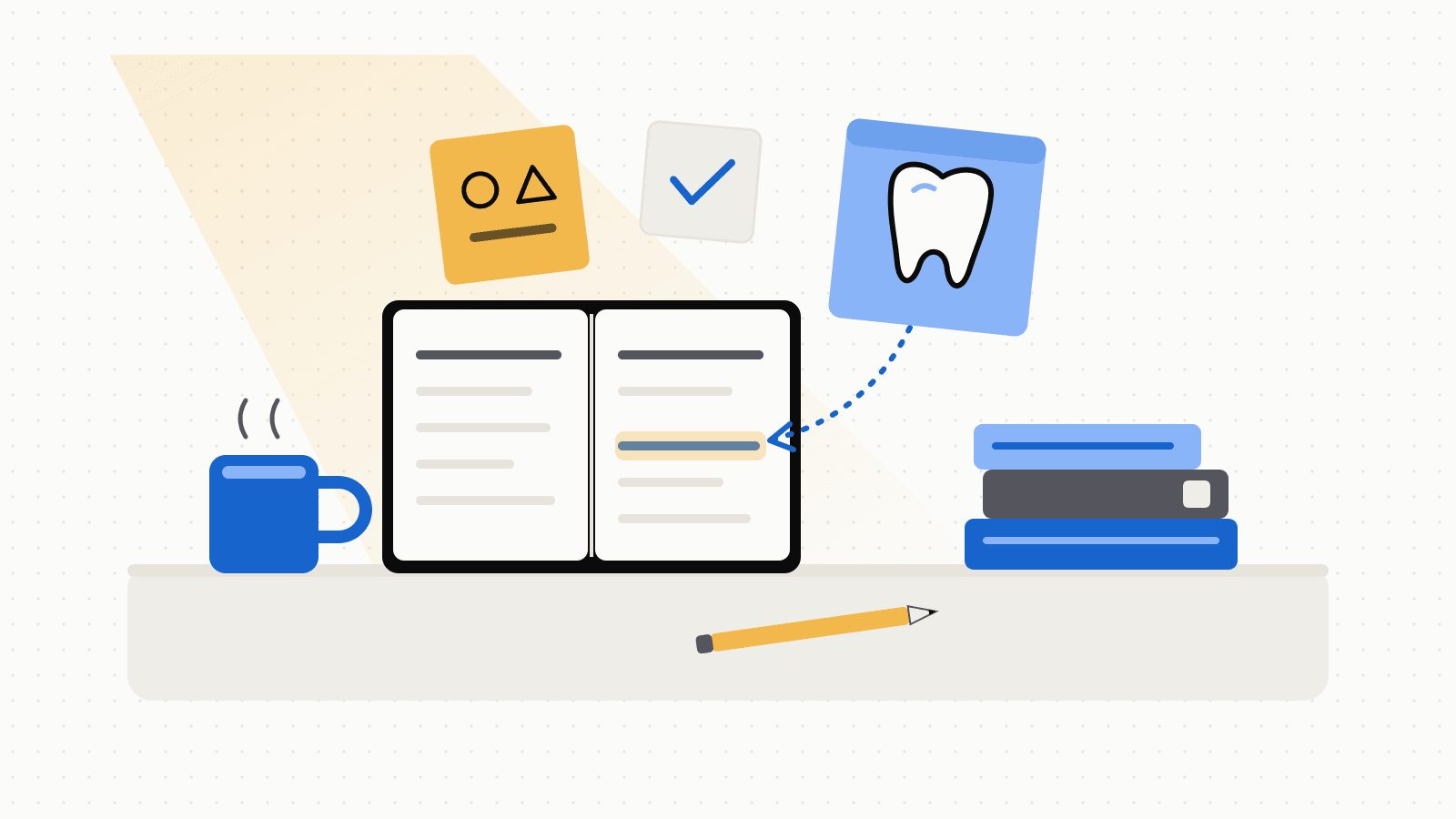
Try a worked example. Take the French word la dent, meaning "tooth." The keyword is "dentist," which sounds similar. Now picture a dentist holding up one giant tooth. One interactive image links sound to meaning (Jurowski, 2015; Putnam, 2015).
Make it yours. Self-generated cues tend to be effective memory tools (Tullis & Finley, 2018). Your own silly image beats a borrowed one.
Test yourself later, without looking. If a cue fails, rebuild it with a stronger image or a clearer link (Tullis & Finley, 2018).
Mnemonic Devices by Subject
Math: PEMDAS cues the order of operations (OpenStax, 2020). Pair it with a reason the order exists, so the letters aren't doing all the work.
Science: HOMES covers the Great Lakes for geography and Earth science (Bellezza, 1981; Putnam, 2015), and an acrostic can cue planetary order (OpenStax, 2020). See our mnemonic devices for the planets and these memory aids for the cranial nerves.
Foreign languages: the keyword method for vocabulary (Jurowski, 2015; Putnam, 2015).
Any course with lists or sequences: acronyms, loci or pegs (Putnam, 2015).
Do Mnemonics Help Students With Learning Disabilities?
Yes, and the evidence is substantial. Mnemonic instruction for students with learning disabilities and other mild disabilities had been studied experimentally for almost 20 years by the time of one major review (Jurowski, 2015). Explicit keyword, pegword and letter techniques effectively address semantic memory difficulties (Jurowski, 2015; Scruggs & Mastropieri, 2000).
The word "explicit" matters. Teachers should show the strategy directly rather than leave students to discover it on their own (Scruggs & Mastropieri, 2000).
Limits: When Mnemonics Help and When Understanding Matters More
Mnemonics are retrieval aids. They don't build critical thinking or deep comprehension (Bellezza, 1981; Putnam, 2015).
Durability is another limit. Associations such as keyword links can fade over long delays unless you add pictorial prompts, spaced retrieval practice or learner-generated cues (Putnam, 2015; Tullis & Finley, 2018).
A sound routine looks like this:
Understand the idea first.
Add a mnemonic for the facts you must recall.
Practice retrieving them over time.
That last step is where active recall and a spaced repetition schedule keep your cues alive.
Frequently asked questions
Are mnemonic devices the same as memorization?
No. They support memorizing facts, but they work by adding meaning and cues rather than by repetition alone (Bellezza, 1981; Putnam, 2015). They do not replace understanding.
What is the most common type of mnemonic device?
First-letter mnemonics, meaning acronyms and acrostics, are the most widely used by learners. The keyword method, stories, songs and imagery follow (Putnam, 2015).
Do mnemonics last, or do you forget them?
Associations can fade over long delays. Spaced retrieval practice and self-generated cues help sustain them (Putnam, 2015; Tullis & Finley, 2018).
Can I use mnemonics for abstract concepts?
It's harder. Mnemonics are retrieval aids rather than tools for building deep comprehension (Bellezza, 1981; Putnam, 2015). Build understanding through explanation and elaboration, and save mnemonics for the factual pieces.
References
Bellezza, F. S. (1981). Mnemonic Devices: Classification, Characteristics, and Criteria. Review of Educational Research. doi.org/10.3102/00346543051002247
Jurowski, K. (2015). Comprehensive review of mnemonic devices and their applications: State of the art. International e-Journal of Science, Medicine & Education. doi.org/10.56026/imu.9.3.4
Putnam, A. L. (2015). Mnemonics in education: Current research and applications. Translational Issues in Psychological Science. doi.org/10.1037/tps0000023
Scruggs, T. E., & Mastropieri, M. A. (2000). The Effectiveness of Mnemonic Instruction for Students with Learning and Behavior Problems: An Update and Research Synthesis. Journal of Behavioral Education. doi.org/10.1023/a:1016640214368
Spielman, R. M., Jenkins, W. J. & Lovett, M. D. (2020). Ways to Enhance Memory - Psychology 2e. OpenStax, Rice University. openstax.org/books/psychology-2e/pages/8-4-ways-to-enhance-memory
SpringerReference (2012). Mnemonic Device. doi.org/10.1007/springerreference_180286
Tullis, J. G., & Finley, J. R. (2018). Self-Generated Memory Cues: Effective Tools for Learning, Training, and Remembering. Policy Insights from the Behavioral and Brain Sciences. doi.org/10.1177/2372732218788092

Discussion