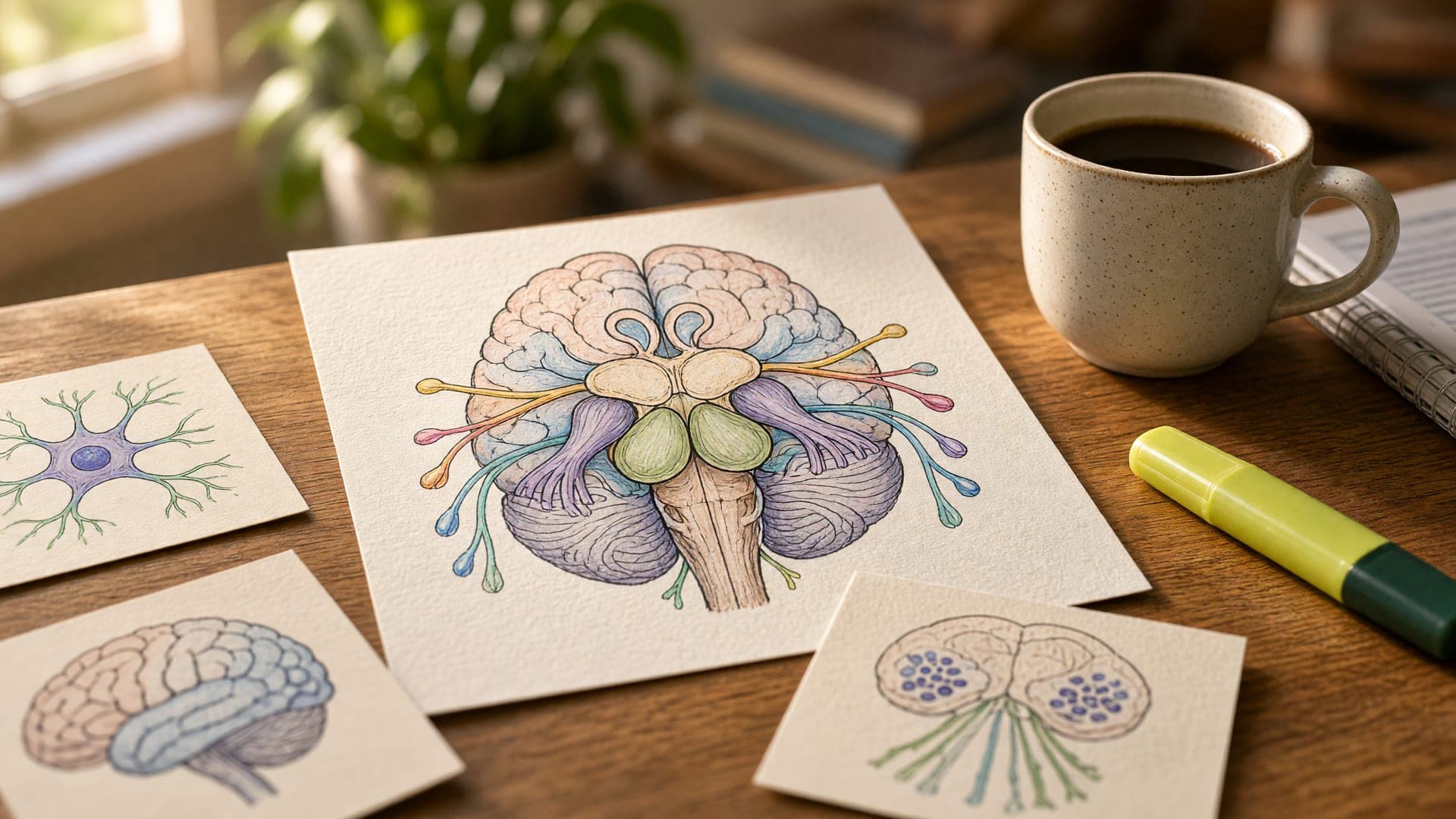
You can name the 12 cranial nerves on a quiz, then blank when someone asks what the trochlear nerve actually does. Order and function are two different memory jobs, and most study aids only cover the first.
This article gives you mnemonic devices for cranial nerves that lock in the numbered order, a second set of cues for sensory, motor, or both, and a reference table of functions. Then it shows you how to build your own images and review them so the knowledge lasts.
Mnemonic Devices for Cranial Nerves: What They Do and Where They Fall Short
Acrostics and acronyms work as organized retrieval pathways. Each letter prompts a word, and the sentence fixes the sequence. That is why they suit arbitrary lists of anatomical terms that must come back in strict order (Bellezza, 1981).
The limit is just as important. A letter mnemonic retrieves names and sequence. It does not teach you what a nerve does, and functional mechanisms need separate, meaningful encoding (Bellezza, 1981; Craik & Lockhart, 1972).
Below you will find the order, the sensory/motor/both pattern, a function table, a method for building your own cues, and a study routine.
The Classic Mnemonics for the 12 Cranial Nerves in Order
First, the nerves by number:
Olfactory
Optic
Oculomotor
Trochlear
Trigeminal
Abducens
Facial
Vestibulocochlear
Glossopharyngeal
Vagus
Accessory
Hypoglossal
The best-known acrostic is "Oh Oh Oh To Touch And Feel A Girl's Vagina, Ah Heaven." It is widely taught, and it is crude. A cleaner option follows the same letters: "On Old Olympus's Towering Top, A Finn And German Viewed Some Hops."
Pair each word with its number
Count aloud as you recite: "One, On (olfactory). Two, Old (optic). Three, Olympus's (oculomotor)." Keep going to twelve. The counting ties each word to a position, so you can answer "which nerve is number 8?" without running the whole sentence.
Watch the repeated letters
The letters O, T, A, and G/V repeat. The letter O alone cannot tell you whether you mean olfactory, optic, or oculomotor. Only the position in the sentence does, so always tie the sentence to the numbers.
Mnemonics for Sensory, Motor, and Both Functions
The standard second mnemonic is "Some Say Marry Money, But My Brother Says Big Brains Matter More." S means sensory, M means motor, and B means both (Bellezza, 1981).
Write the nerve numbers 1 to 12 in a column.
Match each word of the sentence to a number: 1 S, 2 S, 3 M, 4 M, 5 B, 6 M, 7 B, 8 S, 9 B, 10 B, 11 M, 12 M.
Say both mnemonics side by side, one nerve at a time: "One, On, Some: olfactory is sensory." Each name links to its letter (SpringerReference).
Cover one column and recite the other.
Cranial Nerve Table: Number, Name, and Main Function
No. | Name | Type | Main function |
|---|---|---|---|
I | Olfactory | Sensory | Smell |
II | Optic | Sensory | Vision |
III | Oculomotor | Motor | Most eye movements, eyelid elevation, pupil constriction |
IV | Trochlear | Motor | Superior oblique eye movement (down and in) |
V | Trigeminal | Both | Facial sensation and chewing muscles |
VI | Abducens | Motor | Lateral eye movement |
VII | Facial | Both | Facial expression, taste from front of tongue |
VIII | Vestibulocochlear | Sensory | Hearing and balance |
IX | Glossopharyngeal | Both | Taste from back of tongue, swallowing |
X | Vagus | Both | Parasympathetic control of thoracic and abdominal organs, swallowing, voice |
XI | Accessory | Motor | Shoulder shrug and head turning |
XII | Hypoglossal | Motor | Tongue movement |
To use it, cover the function column and try to state each function from the name alone. Then cover the names and work backward from the function.
How to Build a Vivid Mnemonic of Your Own
Borrowed rhymes are a fine start, but images you create yourself often make stronger cues. Vivid, even bizarre, learner-made images tend to produce better retrieval than pre-made ones. The reason is depth of processing: meaningful, deeper thinking leads to more durable learning than shallow letter cues (Craik & Lockhart, 1972).
Pick one nerve and its function.
Turn the name into an image. Picture the optic nerve as a camera cable running from an eye to a screen.
Add action and emotion that match the function.
Place it in a familiar location or on a numbered peg. The memory palace method shows how to do this step by step.
Say the story aloud, then sketch it.
Worked example: the abducens
Imagine an "abductor" grabbing your eye and dragging it outward toward your ear. That one scene cues lateral gaze. Place it at the sixth spot on your route, say beside the sixth step of your staircase, and the number, name, and function all travel together.
Why You Still Forget Functions, and How to Fix It
Mnemonic benefits fade. In a study of a keyword mnemonic for second-language vocabulary, the early advantage shrank without reinforcement (Wang et al., 1992). Treat a mnemonic as scaffolding, not permanent storage.
Two habits keep it standing. Self-testing improves long-term retention far more than repeated reading or passive review (Roediger & Karpicke, 2006). And spreading practice over time beats cramming for verbal recall (Cepeda et al., 2006).
A simple routine
Recite all 12 nerves, with types and functions, from memory.
Write the table blank, then check it and mark the misses.
Repeat on a spaced schedule such as day 1, 3, 7, and 14. This is an illustration, not a research prescription.
Add clinical meaning: for each nerve, ask what a patient could not do if it failed.
Explain each nerve aloud in plain words, as in the Feynman Technique.
The first two steps are active recall. For the timing, a spaced repetition schedule removes the guesswork.
Frequently asked questions
Are student-made mnemonics better than classic ones?
Often, yes. Personal, vivid images tend to make stronger cues because you process them more deeply (Craik & Lockhart, 1972). Classic ones still work as a shared starting point, so customize them with your own images.
How long should I use a mnemonic before testing myself?
Test early, right after a first exposure, rather than rereading. Retrieval practice is what makes the memory last (Roediger & Karpicke, 2006).
Can mnemonics replace understanding cranial nerve physiology?
No. Letter cues retrieve names and order, while function needs separate meaningful encoding (Bellezza, 1981; Craik & Lockhart, 1972). Use mnemonics as scaffolding, then explain each nerve in your own words.
Does a memory palace work for cranial nerves?
It can. Loci and peg systems gave the best strict positional recall in an ordering study (Roediger, 1980). Put one nerve at each location and walk the route in number order.
References
Bellezza, F. S. (1981). Mnemonic Devices: Classification, Characteristics, and Criteria. Review of Educational Research. doi.org/10.2307/1170198
Cepeda, N. J., Pashler, H., Vul, E., Wixted, J. T., & Rohrer, D. (2006). Distributed practice in verbal recall tasks: A review and quantitative synthesis. Psychological Bulletin. doi.org/10.1037/0033-2909.132.3.354
Craik, F. I., & Lockhart, R. S. (1972). Levels of processing: A framework for memory research. Journal of Verbal Learning and Verbal Behavior. doi.org/10.1016/s0022-5371(72)80001-x
Roediger, H. L. (1980). The Effectiveness of Four Mnemonics in Ordering Recall. Journal of Experimental Psychology: Human Learning and Memory. psychnet.wustl.edu/memory/wp-content/uploads/2018/04/Roediger-1980_JEPHLM.pdf
Roediger, H. L., & Karpicke, J. D. (2006). The Power of Testing Memory: Basic Research and Implications for Educational Practice. Perspectives on Psychological Science. doi.org/10.1111/j.1745-6916.2006.00012.x
SpringerReference (2011). Mnemonic Device. SpringerReference. doi.org/10.1007/springerreference_180286
Wang, A. Y., Thomas, M. H., & Ouellette, J. A. (1992). Keyword mnemonic and retention of second-language vocabulary words. Journal of Educational Psychology. doi.org/10.1037/0022-0663.84.4.520


Discussion