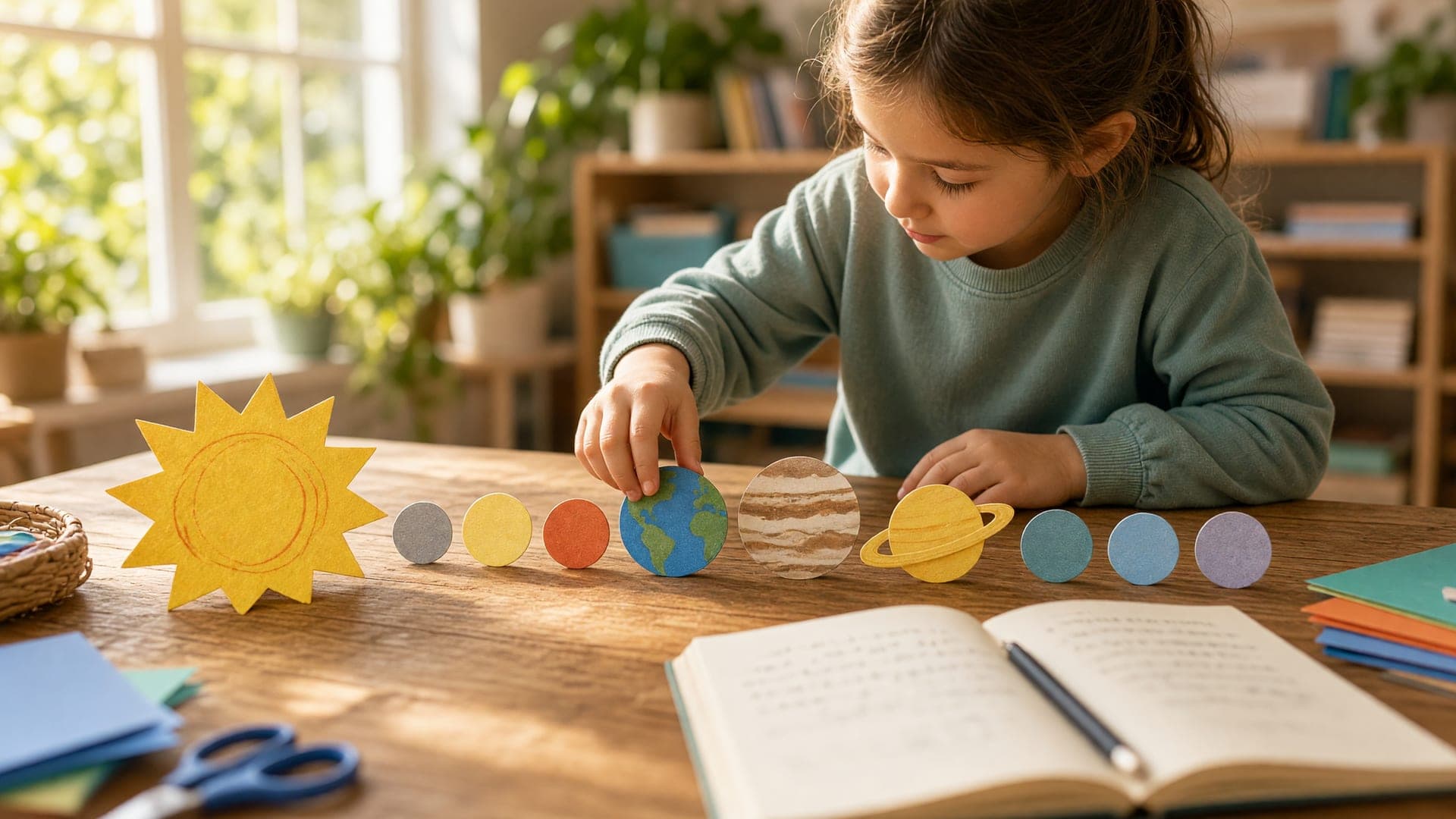
You know the planets are out there, but the order slips away the moment someone asks. Is Mars before Earth? Where does Saturn fit? Many students (and the adults helping them) lose the sequence because it is a list with no built-in logic to hold onto.
Mnemonic devices for planets fix that by giving each name a handle. This article gives you the updated eight-planet sentence, shows how to use it so it sticks, extends the trick to planet size and to inner versus outer groups, and walks through building your own version. A set of activities for home and classroom comes at the end.
The easiest mnemonic devices for planets: the eight-planet sentence
The standard modern sentence is: "My Very Eager Mother Just Served Us Nachos." Each word gives the first letter of a planet, in order from the Sun (IAU astroEDU, 2016; Williams, 2022).
Word | Planet |
|---|---|
My | Mercury |
Very | Venus |
Eager | Earth |
Mother | Mars |
Just | Jupiter |
Served | Saturn |
Us | Uranus |
Nachos | Neptune |
Eight words match the eight planets of our Solar System (Discover the Universe, 2021). The sentence reflects that updated count.
Why the old "pizza" mnemonic changed: Pluto's reclassification
Older sentences had a ninth word for Pluto, such as "...Nine Pizzas." In 2006 the International Astronomical Union (IAU) defined a planet as a body that orbits the Sun, is in hydrostatic equilibrium (massive enough that gravity pulls it into a rounded shape), and has cleared its orbital neighborhood (IAU astroEDU, 2016; Discover the Universe, 2021; Urquhart, 2006). Pluto did not meet the full definition, so it was reclassified as a dwarf planet (IAU astroEDU, 2016).
Pluto was not destroyed or altered. Our understanding of it, and the labels we use, changed. That is science working as intended: definitions get revised when evidence improves (Urquhart, 2006). Clear definitions matter more as discoveries pile up. Astronomers have now found more than 2,000 planets orbiting other stars (IAU astroEDU, 2016).
If a child loves Pluto, keep it as a bonus fact. "Pluto is a dwarf planet" is accurate and memorable, and it doesn't need a ninth word in the sentence.
Mnemonics for size, inner versus outer planets, and more
A common misconception is that mnemonics can only encode distance from the Sun. They can equally capture size rankings or categories (CET, 2005). Here are three goals side by side.
Goal | Order to memorize | Sample approach |
|---|---|---|
Distance from the Sun | Mercury, Venus, Earth, Mars, Jupiter, Saturn, Uranus, Neptune (IAU astroEDU, 2016) | "My Very Eager Mother Just Served Us Nachos" |
Size, largest to smallest | Jupiter, Saturn, Uranus, Neptune, Earth, Venus, Mars, Mercury (CET, 2005) | A separate sentence built from J-S-U-N-E-V-M-M |
Groups | Terrestrial: Mercury, Venus, Earth, Mars. Jovian gas giants: Jupiter, Saturn, Uranus, Neptune (IAU astroEDU, 2016; Williams, 2022) | Remember two groups of four |
Size order is not the same as distance order, so keep the sentences separate and label each one.
Memorizing planets by size
Take the largest-to-smallest order and give it its own sentence. Here is an invented example you can adapt: "Jolly Squirrels Usually Nap Early, Very Mellow Mornings." It is not from the research; it simply fits the letters J-S-U-N-E-V-M-M. Better still, write one about something you love.
Splitting inner and outer planets
The asteroid belt separates the four rocky inner planets from the four outer gas giants (IAU astroEDU, 2016; Williams, 2022). Chunking this way means each group has only four items to carry. First learn the groups, then the order within each. Then the eight-word sentence becomes a check rather than a burden.
Why mnemonic devices work
An ordered list of unrelated names has no structure, so memory has nothing to grab. A mnemonic supplies that structure. Acrostics (sentences built from first letters) and acronyms organize a sequence into a coherent set of cues, and research on organized recall and on mnemonic devices supports this (Bellezza, 1981; Bower et al., 1969). If you are curious how the same idea works in anatomy, see these mnemonic devices for cranial nerves.
Images add power. Dual-coding theory holds that pairing words with vivid mental pictures improves retention compared with words alone (Paivio, 2013). That is why the nachos scene is worth the few seconds it takes to imagine.
Classroom reviews also find that students taught mnemonic strategies recall more vocabulary, lists, and factual content (Levin, 1981; CET, 2005).
How to make your own planet mnemonic: step by step
Writing your own sentence takes active effort, ties each letter to a specific planet, and avoids empty letter-only repetition (Discover the Universe, 2021; CET, 2005; Williams, 2022). Try this method.
List the planets in a column in order and circle the first letter of each.
Pick a theme the learner loves: food, sports, animals, video games.
Build a sentence with one word per letter. Vivid, silly, or personal scenes work best.
Draw or picture the scene to add the visual code (Paivio, 2013).
Say each planet aloud while saying its word, to lock in the letter-to-planet link.
Test yourself later with no notes. Revise any word that trips you up.
Space the practice over several days. This pairs well with spaced repetition, and for bigger lists you might also try the memory palace method.
For example, a soccer fan might write: "My Victorious Eleven Marched Jauntily, Scoring Unbelievable Normal goals." It is odd, but oddness helps. Check it by naming the planet for each word.
Teaching activities for parents and teachers
Sentence contest. Small groups write sentences, share them, and vote. Then each group must name the planet for every word (Discover the Universe, 2021).
Human solar system. Students hold planet cards and line up in order, then recite their sentence.
Card sort. Mix the planet cards. Kids sort by distance, then by size, then into inner and outer groups (CET, 2005).
Draw the sentence. Students illustrate their mnemonic to add imagery (Paivio, 2013).
Pluto discussion. Ask why scientists changed the definition and what evidence matters. A trivia point becomes a lesson in how science works (Urquhart, 2006).
Quick retrieval check. Start the next class by asking for the planets with no notes. This is active recall in its simplest form.
Frequently asked questions
Can I still mention Pluto when teaching the planets?
Yes. Teach it as a dwarf planet reclassified by the IAU in 2006, not as something that was destroyed. It is also a good example of how scientific definitions are refined.
Should kids learn a ready-made mnemonic or invent their own?
A ready-made one is a fine start. Writing their own requires active retrieval and ties each letter to a planet. Many teachers have students do both.
Do mnemonics help beyond astronomy?
Yes. Research on mnemonics covers vocabulary, lists, and factual content across subjects (Levin, 1981; CET, 2005). They work best for ordered or list-like facts, alongside understanding.
How long will it take to remember the order?
It varies by learner. Short practice sessions spread over several days, with self-testing, tend to work best.
References
Bellezza, F. S. (1981). Mnemonic Devices: Classification, Characteristics, and Criteria. Review of Educational Research. doi.org/10.3102/00346543051002247
Bower, G. H., Clark, M. C., Lesgold, A. M., & Winzenz, D. (1969). Hierarchical retrieval schemes in recall of categorized word lists. Journal of Verbal Learning and Verbal Behavior. doi.org/10.1016/s0022-5371(69)80124-6
Center for Educational Technologies, Wheeling Jesuit University (2005). Lesson 4 – Memorizing the Planets in Order. www.e-missions.net/MMAB/pdf/Lessons/lesson4.pdf
Discover the Universe (2021). Recalling the Planets. www.discovertheuniverse.ca/_files/ugd/c07f8f_3abf3cbb84e64819b49233d3a9f3d286.pdf
astroEDU (International Astronomical Union) (2016). Know Your Planets. astroedu.iau.org/activities/know-your-planets/
Levin, J. R. (1981). The mnemonic ‘80s: Keywords in the classroom. Educational Psychologist. doi.org/10.1080/00461528109529231
Paivio, A. (2013). Imagery and Verbal Processes. Psychology Press. doi.org/10.4324/9781315798868
Urquhart, M. L. (2006). Beyond Mnemonics: Pluto and the Nature of Science. The Texas Science Teacher. bpb-us-e2.wpmucdn.com/sites.utdallas.edu/dist/d/917/files/Pluto_Urquhart_06.pdf
Williams, M. (2022). Exploring the Exoplanets: The Search for Habitable Worlds. Yale National Initiative. teachers.yale.edu/curriculum/units/2022/4/5/3

Discussion