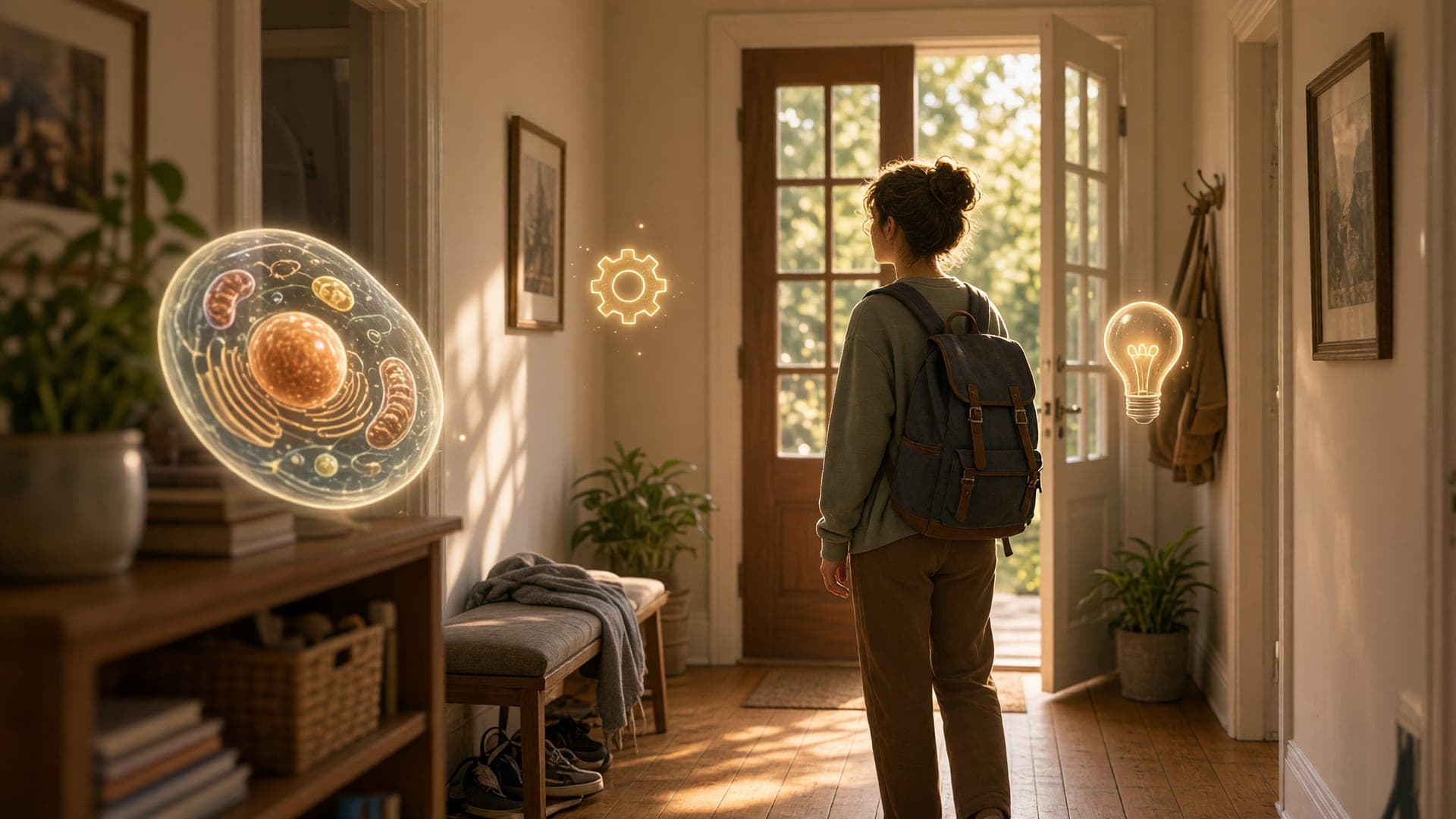
You have a list to learn: ten organelles, the steps of a process, the order of a set of events. You read it three times, and by the next morning half of it has slipped away. Rereading feels productive, but it rarely fixes the order problem.
The memory palace method of loci gives lists a place to live. You attach each item to a stop along a route you already know, then walk the route in your mind to get the items back in order. This guide shows you how to build one, walks through a biology example, and explains what the research does and does not support.
By the end, you will be able to build a ten-stop palace in about the time it takes to make a snack.
What the memory palace method of loci is (and why "palace memory" means the same thing)
The technique is simple. You anchor new information to places along a familiar route. Later, you mentally walk that route and find each piece of information waiting where you left it.
It began in classical rhetoric, where speakers placed parts of a speech at landmarks and then retrieved them in order (Qureshi et al., 2014; Stanford CTL, 2023). "Loci" is just Latin for locations. The "palace" does not need to be grand. Your home, your dorm, or your walk to school will do.
Memory palace vs. method of loci vs. palace memory
These are one technique with different labels. The palace memory method is not a separate system, and you will see all three terms used for the same practice (Qureshi et al., 2014; Stanford CTL, 2023). This guide uses them interchangeably.
Do you need a special memory to use it?
No. Brain imaging of memory champions found no structural differences from ordinary people. What stood out was how they used their brains: they relied on spatial learning regions such as the hippocampus while memorizing (Maguire et al., 2002).
That points to a strategy, not a gift. In a training study, people with no memory expertise learned the method over 6 weeks and showed durable memory gains compared with groups who did working memory training or nothing at all (Wagner et al., 2020). The gains lasted for months, so this is not just a parlor trick (Wagner et al., 2020).
How to build a memory palace: the four steps
Stanford's teaching guidance lays out a four-part protocol (Stanford CTL, 2023):
Choose a familiar location you can picture easily, such as your home.
Plan a fixed, numbered route with distinct stops (the loci), always walked in the same direction.
Turn each item into a vivid, personal, interactive image and place it at its locus.
Mentally walk the route to rehearse, then recall the items in order.
How to choose and design a reliable route
Pick 8 to 12 clearly different spots, such as the front door, shoe rack, hallway mirror and kitchen sink.
Avoid cluttered or look-alike spots. Three identical bookshelves will blur together.
Choose a logical path with no backtracking, so the order becomes automatic.
The place does not have to be one you have known for years. In one study, a briefly studied virtual environment worked as well as a familiar real one (Legge et al., 2012). A game map or a building you studied for a few minutes can serve, as long as you can walk it mentally.
Worked example: memorizing a 10-item biology list
Say you need these ten cell structures in order: nucleus, ribosome, rough ER, Golgi apparatus, mitochondrion, lysosome, vacuole, cell membrane, cytoskeleton, chloroplast.
Walk a ten-stop route through your home and place one image at each stop (Stanford CTL, 2023):
Front door: a giant, brain-like nucleus fills the doorway and will not let you in.
Shoe rack: ribosomes, tiny as peppercorns, spill out of your shoes.
Hallway mirror: a ridged, bumpy ribbon (rough ER) is draped across the glass.
Kitchen sink: a worker stacks and wraps packages in shipping paper for the Golgi apparatus.
Carry on through the rest of the house in the same way. Tie each image to meaning where you can. A power plant humming loudly on the kitchen counter stands for the mitochondrion because it makes the cell's energy.
Exaggerate everything. Make images huge, noisy, funny or messy, and make them do something. Placing a nucleus at the door is weaker than a nucleus that blocks you from walking in (Stanford CTL, 2023).
Rehearse and test
Walk the route twice, naming each item and its function aloud. The next day, walk it forward and then backward without notes. That second step is active recall, and it shows you which stops are weak. Fix those images by making them stranger or more personal.
Adapting it for pathways and complex material
For a pathway, use one locus per step and put the key enzyme or product in the image. This works on real coursework. Medical physiology students who built memory palaces for insulin and diabetes topics outperformed peers taught through lectures and self-directed study (Qureshi et al., 2014).
Making images vivid: what to do and what to avoid
Strong images use movement, emotion, humor, scale and your own senses (Stanford CTL, 2023). Imagine the smell, the sound, the texture. Put yourself in the scene.
Common mistake | Fix |
|---|---|
Loci that look alike | Choose stops that are clearly different from one another |
Several items crammed into one spot | One item per locus |
A route you have not rehearsed | Walk it once or twice before adding items |
Passive images that just sit there | Make them move and interact with the place or with you |
Skipping review | Do a short rehearsal walk |
Using multiple palaces for exams
If you study several subjects, give each its own palace so the cues do not interfere. Reusing one palace for different exams risks old images intruding on new ones (Stanford CTL, 2023).
Sources of palaces include your home, school, commute, a grandparent's house or a virtual space (Legge et al., 2012; Stanford CTL, 2023).
Reuse a palace only after a topic is finished and you can mentally clear or replace its images.
Plan reviews across several days rather than one session. A spaced review schedule keeps the images fresh.
What the research says about spatial memory
Brain studies suggest the method works by borrowing the brain's navigation system. Encoding engages regions tied to spatial navigation and visual processing, including the retrosplenial cortex and parahippocampus. Recall draws on different areas, such as the superior temporal gyrus, which helps track sequence (Mallow et al., 2015).
Training produced durable memories with more efficient neural coding, including lower prefrontal activation, and better hippocampal-neocortical consolidation (Wagner et al., 2020). In plain terms, the memories became more stable and took less mental effort to hold. Good rest helps too, since sleep helps lock in memories.
In another study, participants recalled 10 lists of 11 unrelated words using a quickly learned virtual palace, matching those who used familiar real locations (Legge et al., 2012).
Frequently asked questions
How long does it take to build a first memory palace?
Planning a 10-stop route takes a few minutes. Placing ten images and doing one review walk may take 10 to 15 minutes. One study showed a palace can be built in minutes (Legge et al., 2012).
What if I run out of places?
Add rooms or a second route, or split the material across palaces. Keep stops distinct rather than cramming more items into one locus.
Can I use a place I have never visited, like a video game map?
Yes. A briefly studied virtual environment worked as well as a familiar real one in research (Legge et al., 2012). Study it first until you can walk it mentally.
Does the memory palace replace studying?
No. It organizes lists and sequences, but you still need to understand the material. Combine it with active recall and spaced review.
References
Legge, E. L., Madan, C. R., Ng, E. T., & Caplan, J. B. (2012). Building a memory palace in minutes: Equivalent memory performance using virtual versus conventional environments with the Method of Loci. Acta Psychologica. doi.org/10.1016/j.actpsy.2012.09.002
Maguire, E. A., Valentine, E. R., Wilding, J. M., & Kapur, N. (2002). Routes to remembering: the brains behind superior memory. Nature Neuroscience. doi.org/10.1038/nn988
Mallow, J., Bernarding, J., Luchtmann, M., Bethmann, A., & Brechmann, A. (2015). Superior memorizers employ different neural networks for encoding and recall. Frontiers in Systems Neuroscience. doi.org/10.3389/fnsys.2015.00128
Qureshi, A., Rizvi, F., Syed, A., Shahid, A., & Manzoor, H. (2014). The method of loci as a mnemonic device to facilitate learning in endocrinology leads to improvement in student performance as measured by assessments. Advances in Physiology Education. doi.org/10.1152/advan.00092.2013
Stanford Center for Teaching and Learning (2023). Memory Strategy: Memory Palace. Stanford University Center for Teaching and Learning. ctl.stanford.edu/memory-strategy-memory-palace
Wagner, I. C., Konrad, B. N., Schuster, P., Weisig, S., Repantis, D., Ohla, K., Kühn, S., Fernández, G., Steiger, A., Lamm, C., Czisch, M., & Dresler, M. (2020). Durable memories and efficient neural coding through mnemonic training using the method of loci. Science Advances / PMC. doi.org/10.1101/2020.04.29.067561


Discussion