
Exam season has a familiar rhythm: later nights, earlier mornings, more coffee and, for some, the occasional all-nighter. Sleep is usually the first thing to go, because it seems like the one part of the day that isn't doing anything useful.
The research says the opposite. Sleep is when your brain does some of its most important work on learning: clearing space for new information and strengthening the memories you made during the day. Cutting it short to study more is often a losing trade.
Sleep helps learning twice
Sleep matters at two points in the learning process: before you learn and after you learn.
Before learning: getting ready to take things in
A tired brain is worse at forming new memories. In one experiment, people who had been kept awake all night were significantly worse at remembering new material learned the next day than people who had slept. Brain scans showed reduced activity in the hippocampus, a region essential for forming new memories of facts and events (Yoo et al., 2007).
That matters for everyday studying as well as exams. A late night before a morning lecture makes it harder to learn in that lecture. In a study of high school students who kept daily diaries, sacrificing sleep to study more than usual was followed by more trouble understanding lessons and more difficulty with tests the next day, regardless of how much they usually studied (Gillen-O’Neel, Huynh & Fuligni, 2013).
After learning: consolidation
Memories are fragile when first formed. During sleep the brain stabilises and strengthens them, a process called consolidation. Research suggests that during deep sleep, the brain replays recent experiences and gradually moves them from short-term storage in the hippocampus into longer-term networks in the cortex (Diekelmann & Born, 2010; Walker & Stickgold, 2004).
What happens during a night's sleep
Sleep isn't one uniform state. Through the night you cycle through light sleep, deep sleep (also called slow-wave sleep) and REM sleep, the stage when most vivid dreaming happens. A full cycle takes roughly 90 minutes, and the mix changes as the night goes on:
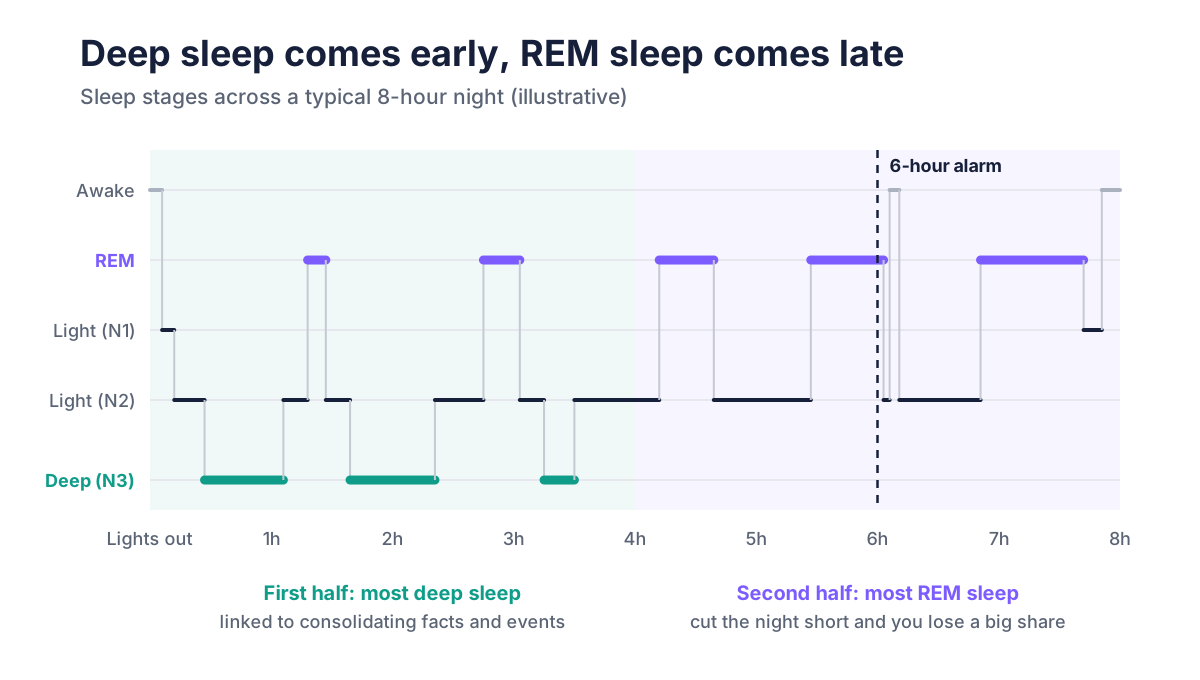
Deep (slow-wave) sleep is concentrated in the first half of the night. It is strongly linked to consolidating facts and events, the kind of memories most exams test.
REM sleep gets longer towards morning. It is linked to processing emotional memories and may help connect new information with what you already know.
Light sleep (especially stage 2) contains bursts of activity called sleep spindles, which are associated with learning skills and procedures.
The practical point is simple. Going to bed late loses you mostly deep sleep. Waking early loses you mostly REM sleep. A full night gives you both.
Sleep and grades
Lab studies are one thing. Does sleep actually relate to grades? Several studies suggest it does.
In a study that gave activity trackers to 88 university chemistry students for a whole term, better sleep quality, longer sleep and more consistent sleep were all associated with better grades. Sleep measures accounted for nearly 25% of the differences in academic performance. Interestingly, sleep on the single night before a test didn't predict performance. Sleep over the previous week and month did (Okano et al., 2019).
In a vocabulary study, people learned foreign words in two sessions twelve hours apart. Those who slept between the sessions needed about half as much practice to relearn the words, and remembered them much better a week and six months later, than those who studied in the morning and evening of the same day (Mazza et al., 2016).
These studies mostly show associations rather than proving cause and effect, but together with the lab research they point clearly in one direction: consistent, sufficient sleep across the whole term supports learning.
How much sleep do you need?
Recommendations from the US National Sleep Foundation, based on an expert review of the evidence (Hirshkowitz et al., 2015):
Age | Recommended sleep per night |
|---|---|
Teenagers (14–17) | 8–10 hours |
Young adults (18–25) | 7–9 hours |
Adults (26–64) | 7–9 hours |
Teenagers face an extra challenge: during adolescence the body clock naturally shifts later, making it harder to fall asleep early. That is biology, not bad habits, and it makes a consistent routine even more important.
A practical sleep plan for students
Keep a consistent schedule
Go to bed and get up at roughly the same time every day, weekends included. Consistency was one of the sleep measures linked to better grades in the Okano study, and it makes falling asleep easier.
Set a caffeine cut-off
Caffeine lingers in the body for hours. In one study, a dose equivalent to a few cups of coffee taken six hours before bedtime still reduced total sleep by more than an hour (Drake et al., 2013). A good rule is no caffeine after early afternoon, including energy drinks, cola and strong tea.
Dim the lights and screens
Bright light in the evening delays your body clock. People who read on a light-emitting tablet before bed took longer to fall asleep, had delayed release of the sleep hormone melatonin, and felt less alert the next morning than when they read a printed book (Chang et al., 2015). Dim the lights in the last hour before bed, use night mode, and ideally put screens away.
Build a wind-down routine
Your brain needs a buffer between intense studying and sleep. Stop demanding work 30–60 minutes before bed. Do something calm, such as reading for pleasure, stretching or a shower, so your body learns that the routine means sleep is coming.
Review before bed, not all night
A short review of key material in the evening, followed by a full night's sleep, is a good combination. The sleep that follows helps consolidate what you have just reviewed. Keep it short, and stop in time to wind down.
Use naps carefully
A short nap of 10–20 minutes in the early afternoon can restore alertness without leaving you groggy. Long or late naps can make it harder to sleep at night.
The night before an exam
Finish studying in the early evening. Do a light recall session on key points instead of learning anything new.
Pack your bag, check the time and place, and lay out what you need.
Wind down as usual and go to bed at your normal time. Going to bed very early often leads to lying awake.
If you can't sleep, don't panic. One slightly short night before an exam matters much less than your sleep over the previous weeks. Rest quietly and trust the work you have done.
When sleep is hard
Stress, worry and irregular schedules make sleep difficult for many students. If you regularly struggle to fall or stay asleep, or feel exhausted despite enough time in bed, speak to your GP or your school or university health service. Cognitive behavioural therapy for insomnia (CBT-I) is an effective, drug-free treatment, and it is often available through health services or structured online programmes.
Watch: sleep is your superpower
The sleep scientist Matt Walker gives a vivid overview of how sleep affects learning, memory and health. Some claims in his popular work have been criticised as overstated, but the core message is well supported: regular, sufficient sleep matters for learning.
Frequently asked questions
Can I catch up on sleep at the weekend?
Sleeping longer at weekends can reduce tiredness, but it doesn't fully undo the effects of short sleep during the week on attention and learning. Large swings in bedtime also disrupt your body clock, which makes Monday nights harder. Consistency is the better goal.
Does studying right before sleep help memory?
Sleep soon after learning seems to support consolidation, so a short evening review is sensible. Avoid long, stressful sessions late at night that push back your bedtime or leave your mind racing.
Is it better to sleep or study if I'm behind?
Occasionally trimming sleep by a small amount is unlikely to cause harm, but regularly cutting it to study more tends to backfire: you learn less efficiently the next day and retain less of what you studied. Study smarter with recall and spacing, and protect your sleep.
References
Chang, A.-M., Aeschbach, D., Duffy, J. F., & Czeisler, C. A. (2015). Evening use of light-emitting eReaders negatively affects sleep, circadian timing, and next-morning alertness. Proceedings of the National Academy of Sciences, 112(4), 1232–1237. doi.org/10.1073/pnas.1418490112
Diekelmann, S., & Born, J. (2010). The memory function of sleep. Nature Reviews Neuroscience, 11(2), 114–126. doi.org/10.1038/nrn2762
Drake, C., Roehrs, T., Shambroom, J., & Roth, T. (2013). Caffeine effects on sleep taken 0, 3, or 6 hours before going to bed. Journal of Clinical Sleep Medicine, 9(11), 1195–1200. doi.org/10.5664/jcsm.3170
Gillen-O’Neel, C., Huynh, V. W., & Fuligni, A. J. (2013). To study or to sleep? The academic costs of extra studying at the expense of sleep. Child Development, 84(1), 133–142. doi.org/10.1111/j.1467-8624.2012.01834.x
Hirshkowitz, M., et al. (2015). National Sleep Foundation’s sleep time duration recommendations: Methodology and results summary. Sleep Health, 1(1), 40–43. doi.org/10.1016/j.sleh.2014.12.010
Mazza, S., Gerbier, E., Gustin, M.-P., Kasikci, Z., Koenig, O., Toppino, T. C., & Magnin, M. (2016). Relearn faster and retain longer: Along with practice, sleep makes perfect. Psychological Science, 27(10), 1321–1330. doi.org/10.1177/0956797616659930
Okano, K., Kaczmarzyk, J. R., Dave, N., Gabrieli, J. D. E., & Grossman, J. C. (2019). Sleep quality, duration, and consistency are associated with better academic performance in college students. npj Science of Learning, 4, 16. doi.org/10.1038/s41539-019-0055-z
Walker, M. P., & Stickgold, R. (2004). Sleep-dependent learning and memory consolidation. Neuron, 44(1), 121–133. doi.org/10.1016/j.neuron.2004.08.031
Yoo, S.-S., Hu, P. T., Gujar, N., Jolesz, F. A., & Walker, M. P. (2007). A deficit in the ability to form new human memories without sleep. Nature Neuroscience, 10(3), 385–392. doi.org/10.1038/nn1851



Discussion