
You have four CPA exam sections to pass, a full-time job, and a testing window that keeps running whether you study or not. A good study schedule for CPA exam candidates has to survive busy season, sick kids, and the week you simply run out of energy.
This article gives you a plan built on the numbers: how many hours each section takes, how to turn those hours into weekly time, which section to take first, and what to do if you fail one. You will leave with a calendar you can actually fill in.
What a Workable Study Schedule for the CPA Exam Looks Like
Start with the budget. Exam prep guidelines recommend about 150 to 170 hours of study per section (Gleim, 2023). Across four sections, that is roughly 600 to 680 hours (simple arithmetic from that guideline).
Next, the timeline. Aim to finish all four sections within 12 months. Jurisdictions allow 18 to 30 months, but educators note that stretching past 12 sharply increases attrition and the chance you never finish (AICPA, 2023). The longer window does not make passing easier. It mostly gives motivation more time to fade.
Three design rules hold a schedule together:
Spread sessions out instead of relying on a few giant blocks.
Build in buffer so one bad week does not wreck the plan.
Set firm exam dates so the plan has a deadline.
The sections below cover hours, order, sample weeks, buffer time, and retakes.
How Many Hours and Weeks Per Section
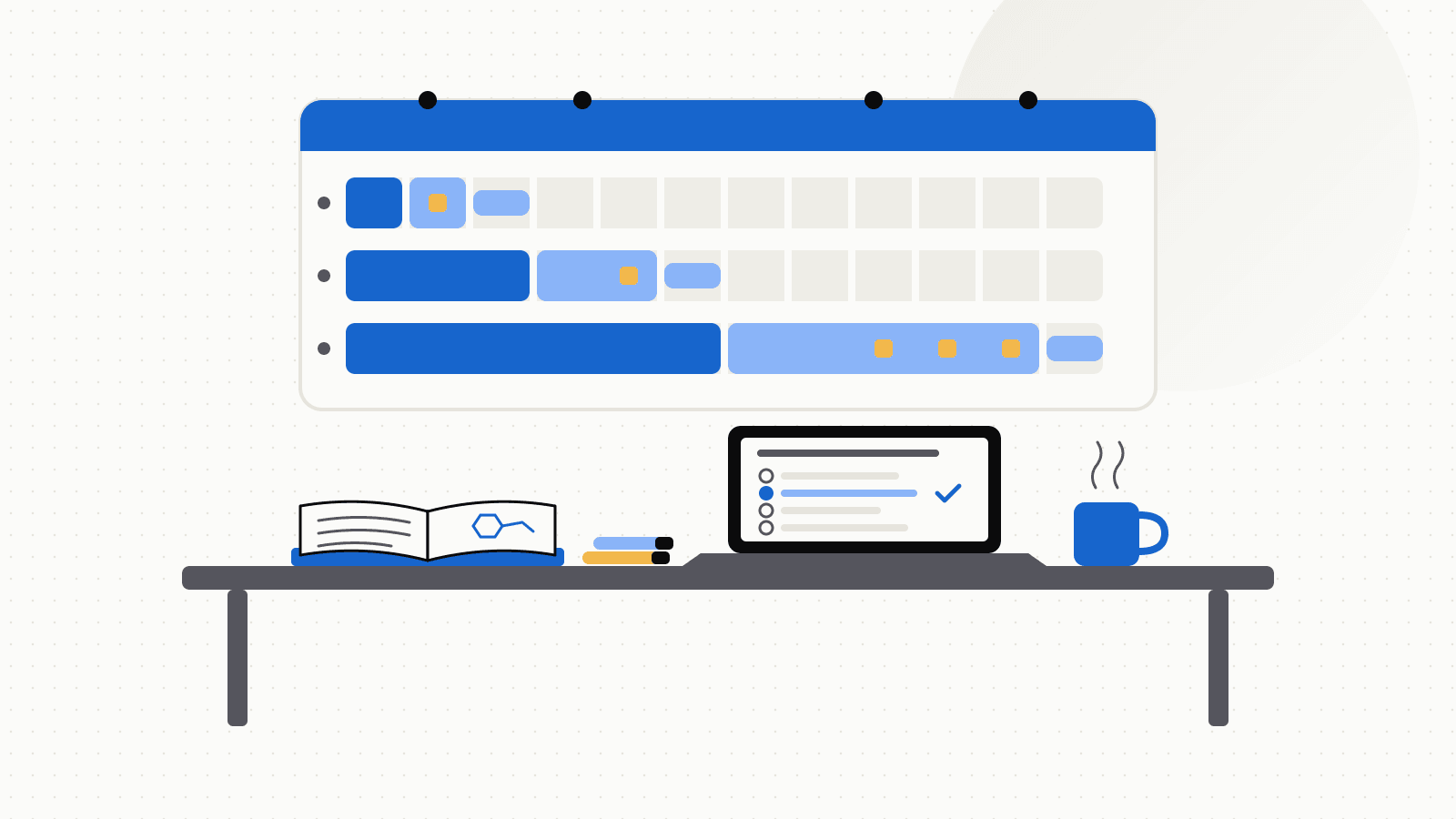
Two common paces exist. Candidates on a fast-track, six-month plan budget roughly 6 to 7 weeks of study per section. Working candidates who need refreshers typically budget 10 to 12 weeks per section, about one section per quarter (Gleim, 2023).
Here is the math, which is our calculation from the 150 to 170 hour guideline. Over 10 to 12 weeks, that is roughly 13 to 17 hours a week. Over 6 to 7 weeks, it is roughly 21 to 28 hours a week.
Quick comparison of pacing options
Pacing | Weeks per section | Approximate weekly hours | Best for |
|---|---|---|---|
Fast-track | 6 to 7 | 21 to 28 | Candidates with flexible schedules or lighter work seasons |
Standard working pace | 10 to 12 | 13 to 17 | Full-time workers who need refreshers |
Hours per week are our calculations from the guideline figures (Gleim, 2023). If you face busy season or heavy work travel, a slower lane for that stretch may be the honest choice.
Which Order Should You Take the Four Sections?
One observational study of 121,234 candidates from 2005 to 2013 found that those who took FAR first finished the full exam faster and were least likely to lose credit under rolling window rules. Candidates who took BEC first took significantly longer overall and were most likely to lose credit for sections they had already passed (Bline et al., 2016).
That challenges a popular idea: that starting with the easiest section is always best. The data does not support "always."
Practical options:
Default to FAR first unless you have a strong reason not to.
Match order to your work calendar and background. If your job keeps you close to certain material, that may shape what you take second or third.
Book the first exam early so the clock starts on your terms.
Sample Weekly Schedules: Full-Time Workers and Flexible Candidates
Spacing matters more than most candidates expect. A review of distributed practice research found that spreading study over time improves long-term recall compared with massing it together (Cepeda et al., 2006). A single 10-hour weekend marathon does not do the same job as the same hours split across the week.
Full-time working candidate
A common pattern is about 2 hours on weeknights and 6 to 8 hours on weekend days, with one full day off (Journal of Accountancy, 2016). Here is one way to lay it out:
Day | Plan | Hours |
|---|---|---|
Monday | Focused study after work | 2 |
Tuesday | Focused study after work | 2 |
Wednesday | Flexible buffer | 0 to 2 |
Thursday | Focused study after work | 2 |
Friday | Light review or off | 0 to 1 |
Saturday | Long session, split with breaks | 6 to 8 |
Sunday | Rest, or a short makeup session | 0 to 2 |
That lands in the 13 to 17 hour range. Split the Saturday block into two or three sessions with real breaks. Pair this with a spaced repetition review schedule so earlier topics keep resurfacing.
Candidate with more flexibility
If you are between jobs, part-time, or in a light season, you can use longer weekday daytime blocks and aim for the fast-track pace of about 6 to 7 weeks per section (Gleim, 2023). Add a weekly practice test and review it carefully. Still protect one full rest day to prevent burnout (Journal of Accountancy, 2016).
What to do inside each session
Favor practice questions and mock exams over rereading. A meta-analysis found that practice testing produces significantly stronger learning and retention than passive restudy or note rereading (Adesope et al., 2017).
Build Your CPA Study Schedule Step by Step
Pick your pace. Choose 10 to 12 weeks or 6 to 7 weeks per section, based on the weekly hours you can actually protect.
Choose a section order and map four study blocks onto a calendar.
Book the exam date 6 to 8 weeks ahead and pay upfront. A firm date and sunk fee create a hard deadline (AICPA, 2023; Gleim, 2023). If you struggle to start, these tactics to stop procrastinating help.
Add a weekly makeup block for work or family surprises (Organized CPA, 2023).
Reserve the final 1 to 2 weeks before each exam for practice simulations and targeted review (AICPA, 2023).
Shift toward practice questions as the exam nears, and track weak topics. This is studying by testing yourself, and it should take a growing share of your time.
Schedule one full non-study day each week (Journal of Accountancy, 2016).
For placing sessions on the calendar, time-blocking works well: assign each study session a specific start time and treat it like a meeting.
How Much Buffer Time to Build In
Unexpected disruptions are inevitable, so a good plan has two layers of buffer (Organized CPA, 2023; AICPA, 2023):
Weekly makeup blocks that absorb a missed evening.
A 1 to 2 week pre-exam review period for simulations and targeted review.
Expect busy season, illness, and family needs. A schedule with zero slack breaks on the first one. A simple rule: leave at least one weekly session unassigned, so a missed day does not cascade into the next.
Buffer is not the same as stretching the timeline. Keep the 12-month finish in sight (AICPA, 2023). Rest also protects study quality, which is why a full day off belongs in the plan (Journal of Accountancy, 2016). For more, see why sleep matters for memory.
Retakes and the Testing Window
If you do not pass a section, reschedule and retake that same section promptly while the content is still fresh. Jumping to a new section to "keep momentum" lets what you learned fade (AICPA, 2023).
After a fail, review your score report, identify weak areas, and run a shorter, targeted plan before the retake. You are not starting over.
Rolling credit windows historically run 18 to 30 months depending on jurisdiction, so check your own board's rules (AICPA, 2023). Losing credit is a real risk when sections are spread far apart, and the order research shows some candidates do lose credit (Bline et al., 2016). A faster finish helps, and so does planning for one retake. Put a possible retake slot in your calendar from the start.
Frequently asked questions
How many hours a week should I study for the CPA exam while working full-time?
A rough range is 13 to 17 hours a week at a 10 to 12 week pace per section, calculated from the 150 to 170 hour guideline (Gleim, 2023). The pattern of about 2 hours on weeknights and 6 to 8 hours on weekend days fits this, with one day fully off (Journal of Accountancy, 2016).
Is it better to study a little every day or in big weekend blocks?
Spreading sessions over time improves long-term recall compared with massed cramming (Cepeda et al., 2006). Combine short weeknight sessions with a couple of longer weekend blocks that include breaks.
Should I schedule my exam before I feel ready?
Yes, within reason. Booking a date 6 to 8 weeks ahead creates accountability and counters procrastination (AICPA, 2023). Use the final 1 to 2 weeks for practice simulations and targeted review.
What is the best way to use practice questions in my schedule?
Practice testing produces stronger learning than rereading or passive review (Adesope et al., 2017). Increase the share of practice questions and mock exams as exam day approaches.
References
Adesope, O. O., Trevisan, D. A., & Sundararajan, N. (2017). Rethinking the Use of Tests: A Meta-Analysis of Practice Testing. Review of Educational Research. doi.org/10.3102/0034654316689306
AICPA / ThisWayToCPA (2023). 8 tips for creating a successful CPA exam schedule. www.thiswaytocpa.com/exam/articles/passing-exam/creating-successful-cpa-exam-schedule/
Bline, D., Perreault, S., & Zheng, X. (2016). An exploratory examination of order effects on CPA exam passage timeliness. Journal of Accounting Education. doi.org/10.1016/j.jaccedu.2016.05.003
Cepeda, N. J., Pashler, H., Vul, E., Wixted, J. T., & Rohrer, D. (2006). Distributed practice in verbal recall tasks: A review and quantitative synthesis. Psychological Bulletin. doi.org/10.1037/0033-2909.132.3.354
Gleim CPA Review (2023). Making a CPA Exam Study Plan. www.gleim.com/cpa-review/blog/cpa-exam-study-plan/
Journal of Accountancy (2016). How to find time to study for the CPA Exam. www.journalofaccountancy.com/news/2016/may/find-time-to-study-for-cpa-exam-201614163/
Organized CPA (2023). How to create a study schedule to pass the CPA exams. organizedcpa.com/cpaexamschedule/

Discussion