
You have an essay due on Friday. It is Tuesday evening. You open the document, look at the blank page, and suddenly your desk needs tidying, a video needs watching and a friend's message needs a very thoughtful reply. By Thursday night you are writing at speed, stressed and annoyed with yourself.
If that sounds familiar, you are in large company. Estimates suggest that 80–95% of university students procrastinate, and around half do so consistently enough for it to cause problems (Steel, 2007). The good news is that procrastination is well studied, and the research points to strategies that work much better than "just try harder".
Procrastination is about feelings, not time
Procrastination means voluntarily delaying something you intend to do, even though you expect to be worse off for it. That last part is what makes it different from sensible prioritising.
It is tempting to see it as laziness or poor time management. Researchers increasingly see it differently: as a way of managing emotions. When a task makes us feel anxious, bored, confused or inadequate, avoiding it brings instant relief. We trade our future self's wellbeing for a better mood right now (Sirois & Pychyl, 2013).
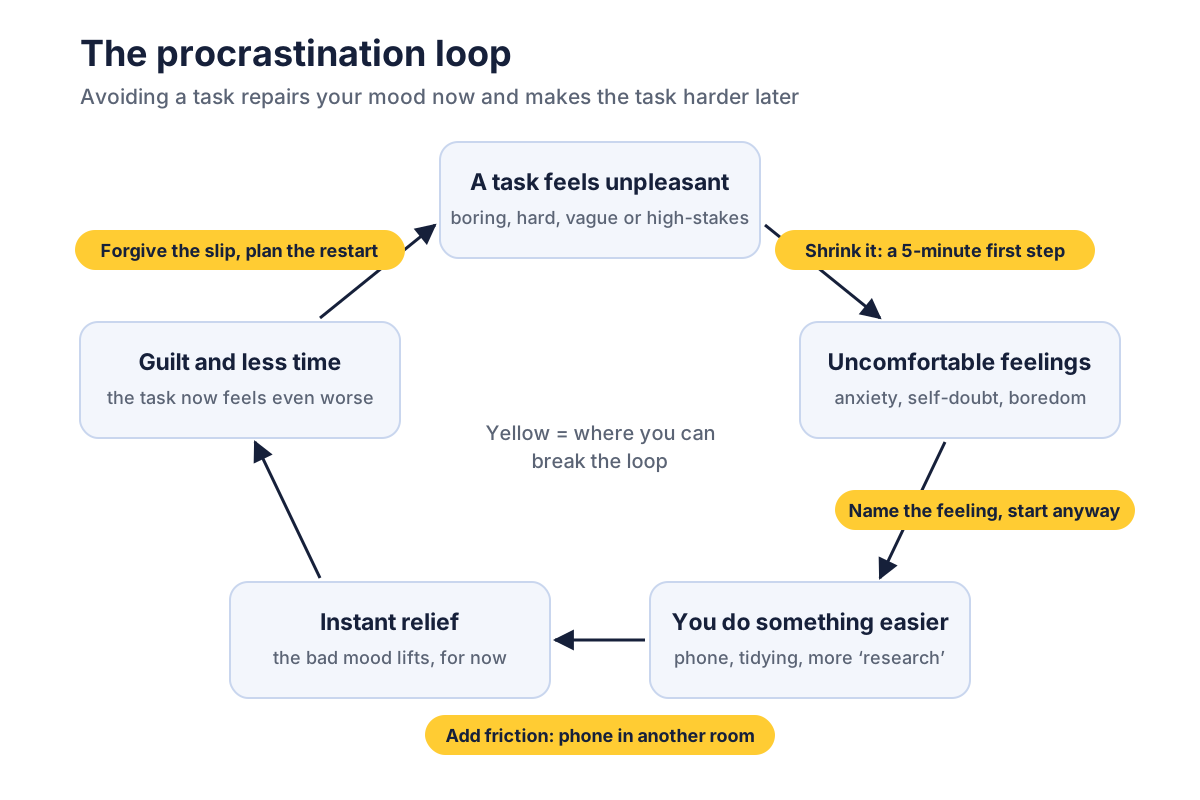
This explains some puzzling facts. Procrastinators aren't usually relaxing: they often feel worse while avoiding. It also explains why time-management apps alone rarely fix the problem. If the real issue is how a task makes you feel, the solution has to address the feeling as well as the schedule.
Tasks are most likely to be avoided when they are boring, frustrating, difficult, vague, unstructured, or lacking personal meaning. Look at the essay you are putting off: how many of those boxes does it tick?
The procrastination equation
The psychologist Piers Steel combined hundreds of studies into a simple model of motivation (Steel, 2007). Roughly:
It is a simplification, but a useful one. It gives you four levers: raise your confidence, raise the value of the task, reduce distraction, and bring the payoff closer. Each strategy below pulls on one or more of them.
10 strategies that work
1. Make the first step tiny and concrete
"Write essay" is vague and huge, which makes it feel threatening. "Open the document and write three bullet points for the introduction" is small and clear. Shrink the first step until it seems almost silly not to do it.
Starting is usually the hardest part. Once you have begun, momentum and curiosity often carry you further than you planned.
2. Decide exactly when and where: if-then plans
Intentions like "I'll revise more this week" rarely survive contact with real life. Implementation intentions are specific if-then plans: "If it is 4pm on Tuesday and I'm back from lectures, then I will sit at my desk and do five past-paper questions."
A meta-analysis of 94 studies found that forming if-then plans had a medium-to-large effect on actually reaching goals (Gollwitzer & Sheeran, 2006). They work because the decision is made in advance. When the moment arrives, you don't have to summon motivation. You just follow the plan.
3. Commit to just five minutes
Tell yourself you will work for five minutes, and that you are allowed to stop afterwards. It lowers the emotional cost of starting, and you will usually keep going. If you genuinely want to stop after five minutes, stop, and schedule the next five.
The Pomodoro Technique, created by Francesco Cirillo in the late 1980s, builds on the same idea: 25 minutes of focused work, then a 5-minute break, with a longer break after four rounds. The timer turns an open-ended task into a series of manageable sprints.
4. Put distance between you and your phone
Distraction is the impulsiveness part of the equation, and your phone is its most efficient delivery system. One study found that people performed worse on demanding tasks when their phone was on the desk, even face down and silent, than when it was in another room (Ward et al., 2017). Later replications have been mixed, but the practical advice costs nothing: put the phone in another room, or at least in a bag, out of sight.
Do the same on your computer. Use a website blocker during study sessions, close email and chat, and keep only the tabs you need.
5. Create closer deadlines
Distant deadlines have little pull. Break large projects into stages with their own deadlines (outline by Monday, first section by Wednesday, draft by Friday) and make them public if you can: tell a friend, a study group or your tutor. External accountability brings the "delay" in the equation much closer.
6. Make the task more rewarding
Increase the value side of the equation. Two approaches help:
Connect it to something you care about. Remind yourself why the task matters to you: the course you want, the job you are aiming for, the skill you are building.
Bundle it with something you enjoy. Keep a favourite treat, playlist or café only for study sessions. In one study, people who could only listen to gripping audiobooks at the gym went to the gym more often (Milkman, Minson & Volpp, 2014). This is called temptation bundling.
7. Build your confidence with early wins
We avoid tasks when we doubt we can do them, which is the expectancy side of the equation. Start with the part you know best, study a worked example before attempting problems, or ask for help early. Each small success makes the next step feel more achievable.
8. Name the feeling, then start anyway
When you notice the urge to avoid a task, pause and name what you feel: "I'm anxious this essay won't be good enough", or "this reading is boring and I'm tired". Naming a feeling takes some of its power away. Then remind yourself that you don't need to feel like doing something in order to do it. Motivation often follows action rather than preceding it.
9. Forgive yourself for past procrastination
This sounds soft, but it has evidence behind it. In a study of university students, those who forgave themselves for procrastinating before their first exam procrastinated less before the next one (Wohl, Pychyl & Bennett, 2010). Harsh self-criticism adds more bad feelings to the task, which is exactly what drives avoidance. Acknowledge the slip, learn from it, and plan your restart.
10. Plan your week around real energy
Schedule demanding work for the times of day when you are most alert, and save admin and easy tasks for low-energy slots. Keep a realistic plan. An impossible schedule sets you up to fail, and failure feeds avoidance. A short "done list" at the end of each day, noting what you actually achieved, is often more motivating than a long to-do list.
When it is more than procrastination
Sometimes persistent difficulty starting and finishing work is a sign of something else, such as depression, an anxiety disorder or ADHD. If procrastination is seriously affecting your studies or wellbeing, or you recognise other signs such as low mood, constant worry or long-standing problems with attention, talk to your GP, your school or university counselling service, or a student support team. Getting the right support is not a failure of willpower.
Watch: inside the mind of a procrastinator
Tim Urban's TED talk is a funny and honest description of what procrastination feels like from the inside, and why deadlines, or their absence, matter so much.
Frequently asked questions
Is procrastination a sign of laziness?
Usually not. Many procrastinators work very hard once they start, and often feel worse, not relaxed, while avoiding tasks. It is better understood as a problem of managing emotions than of effort.
Does working under pressure help me perform better?
Deadlines can feel energising, but last-minute work tends to leave less time to check, revise and learn. It is also associated with more stress. Most people who "work best under pressure" simply haven't tried working without it.
What is the best app for procrastination?
No app fixes the underlying feelings, but some reduce distraction. Website blockers, focus timers and phone focus modes help with the impulsiveness part of the problem. Pair them with the strategies above.
References
Gollwitzer, P. M., & Sheeran, P. (2006). Implementation intentions and goal achievement: A meta-analysis of effects and processes. Advances in Experimental Social Psychology, 38, 69–119. doi.org/10.1016/S0065-2601(06)38002-1
Milkman, K. L., Minson, J. A., & Volpp, K. G. M. (2014). Holding the Hunger Games hostage at the gym: An evaluation of temptation bundling. Management Science, 60(2), 283–299. doi.org/10.1287/mnsc.2013.1784
Sirois, F., & Pychyl, T. (2013). Procrastination and the priority of short-term mood regulation: Consequences for future self. Social and Personality Psychology Compass, 7(2), 115–127. doi.org/10.1111/spc3.12011
Steel, P. (2007). The nature of procrastination: A meta-analytic and theoretical review of quintessential self-regulatory failure. Psychological Bulletin, 133(1), 65–94. doi.org/10.1037/0033-2909.133.1.65
Ward, A. F., Duke, K., Gneezy, A., & Bos, M. W. (2017). Brain drain: The mere presence of one’s own smartphone reduces available cognitive capacity. Journal of the Association for Consumer Research, 2(2), 140–154. doi.org/10.1086/691462
Wohl, M. J. A., Pychyl, T. A., & Bennett, S. H. (2010). I forgive myself, now I can study: How self-forgiveness for procrastinating can reduce future procrastination. Personality and Individual Differences, 48(7), 803–808. doi.org/10.1016/j.paid.2010.01.029


Discussion