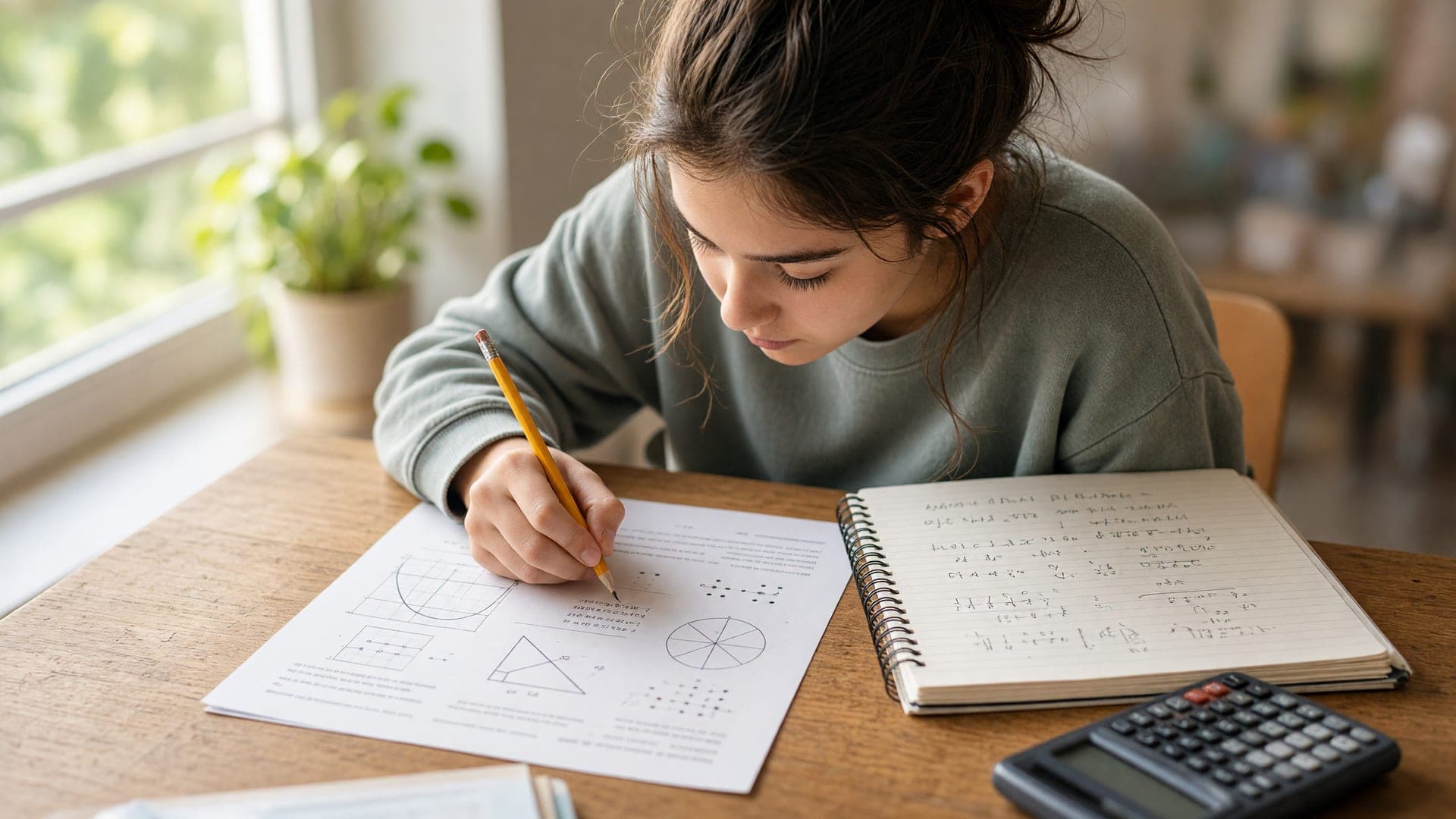
You sat down with a SAT prep test math section, got a score that surprised you, and now you are not sure what to fix. Reviewing everything is too much. Doing hundreds of random problems feels productive but may not be.
This article walks through sample questions from each content area, the traps that cost points, a pacing routine, and a two-week plan that turns one practice test into a focused study schedule. You will also see why the way you practice matters as much as how much you practice.
What SAT Prep Test Math Covers: The Four Content Areas
The Digital SAT math section is organized into four domains:
Algebra: linear equations, systems of equations, inequalities and functions.
Advanced Math: quadratics and other nonlinear functions.
Problem-Solving and Data Analysis: percents, ratios, tables and graphs.
Geometry and Trigonometry: circles, triangles, area, volume and right-triangle trig.
Algebra carries about 33% of the math content (College Board, 2023). That is roughly one question in three, so it deserves steady attention. The rest of the test is spread across the other three domains, so no single topic can carry your score. A student who is excellent at algebra but avoids geometry will leave points on the table.
Below you will find sample questions by type, the traps that go with each, pacing advice, and a study plan.
Algebra Practice Questions With Step-by-Step Solutions
Algebra is the largest domain, so start there. Try the problem below the way you would on test day: cover the solution, attempt it, then compare.
A worked system-of-equations example
Problem (original practice question): A school sells tickets to a play. Student tickets cost $6 and adult tickets cost $10. A total of 80 tickets were sold for $560. How many adult tickets were sold?
Define the variables. Let s be student tickets and a be adult tickets.
Write one equation for the count. s + a = 80.
Write one equation for the money. 6s + 10a = 560.
Substitute. From the first equation, s = 80 − a. Put that into the second: 6(80 − a) + 10a = 560.
Simplify. 480 − 6a + 10a = 560, so 4a = 80, and a = 20.
Check by substituting back. If a = 20, then s = 60. Money: 6(60) + 10(20) = 360 + 200 = 560. It works.
Notice the reasoning behind each step, not just the arithmetic. Step 1 matters because the question asks for adult tickets, not student tickets. Solving for the wrong variable is a classic trap: you finish the algebra, find s = 60, and select it. Underline what the question asks for before you start, and glance at it again before you answer.
Why worked examples beat guesswork
Some students think reviewing a worked solution is passive. The research points the other way. Sweller and Cooper found that studying worked examples helped learners grasp algebra more efficiently than solving problems with no guidance (Sweller & Cooper, 1985). The reason is cognitive load: when you are new to a skill, hunting for a method uses up your working memory, leaving little room to notice the pattern. A worked solution frees that space so you can build a mental template, or schema, for that kind of problem (Sweller & Cooper, 1985).
The benefit is strongest for novice and intermediate learners (Sweller & Cooper, 1985). So treat worked solutions as a bridge, not a destination. Study one, then try a similar problem on your own.
Advanced Math, Data Analysis, Geometry and Trigonometry: Sample Questions and Traps
These are original practice illustrations. The official sources listed later hold real questions, which are the better test of your readiness. The point here is recognizing which strategy fits.
Advanced Math
Sample: If x² − 5x − 14 = 0, what is the positive solution?
First identify the form: a quadratic with a leading coefficient of 1. Look for two numbers that multiply to −14 and add to −5. Those are −7 and 2, so (x − 7)(x + 2) = 0, and the positive solution is 7. If factoring does not appear quickly, complete the square or use the quadratic formula instead.
Trap: sign errors. Students pick 7 and −2 as the pair, then write the solutions with the wrong signs. Plug 7 back in: 49 − 35 − 14 = 0.
Problem-Solving and Data Analysis
Sample: A table shows that 45 of 150 surveyed students walk to school. What percent of the students walk?
Read the question, then the data. Underline what is being asked: a percent, not a count. Then 45 ÷ 150 = 0.30, or 30%.
Trap: misreading a table or graph label, such as using a column for the wrong group or missing that a axis is in thousands.
Geometry and Trigonometry
Sample: In a right triangle, the hypotenuse is 13 and one leg is 5. What is the sine of the angle opposite the leg of length 5?
Sketch the figure and label every known value first. Sine is opposite over hypotenuse, so the answer is 5/13.
Trap: mixing up which side is "opposite" and which is "adjacent," or ignoring units when the question changes from inches to feet.
Domain | First move | Typical trap |
|---|---|---|
Algebra | Underline what is asked | Solving for the wrong variable |
Advanced Math | Identify the form | Factoring and sign errors |
Data Analysis | Read the question, then the data | Misreading labels or units |
Geometry/Trig | Sketch and label | Mixing up units or angle relationships |
Pacing Strategies for SAT Math Prep Questions
Official College Board guidance notes that questions vary in difficulty (College Board, 2020). Not every item is worth the same amount of your time. Lingering on one hard problem drains minutes that could secure easier points later.
Make a quick first pass. Answer what you can solve cleanly.
Mark and skip. If you are stuck after a short attempt, mark the question, pick your best guess if you like, and move on.
Return with leftover time. Spend it on the marked questions, starting with the ones that felt closest.
Many students believe that wrestling with one impossible question for five minutes is worth it. It rarely is. Skipping and returning protects the points you can actually get (College Board, 2020).
Pacing is a skill built by timed practice, not only by knowing content. Practice the skip-and-return routine on timed sets so it feels automatic.
Why Mixed Practice Beats Drilling One Topic at a Time
Textbooks usually group problems by topic: ten quadratics, then ten percent questions. That makes each set easier, because you already know which method to use. The SAT does not do that. It mixes topics, so you must decide which strategy fits each question (Rohrer & Taylor, 2007; Rohrer et al., 2014).
That decision is what mixed practice trains. In one controlled experiment, students who practiced with mixed problems scored 63% on a later test, compared with 20% for students who practiced in blocks (Rohrer & Taylor, 2007). A middle-school classroom study found a similar pattern: 72% for interleaved practice versus 38% for blocked practice on an unannounced test (Rohrer et al., 2014). The benefit held even for problem types that were not superficially similar (Rohrer et al., 2014).
Spacing helped too. Students who split practice across two sessions averaged 74% on the test, versus 49% for those who massed it in one session (Rohrer & Taylor, 2007).
So build mixed sets that combine all four domains, and spread them across several days. If you want help designing the schedule, build a review schedule that actually works.
Turn a Practice Test Into a Targeted Two-Week Study Plan
Taking full official practice tests and cataloging missed questions lets you drill narrow skills instead of reviewing every concept at once (SAT Math Central, 2024). Here is a method.
Take a full official practice test under timed conditions. Treat it like the real thing.
Log every miss. Record the domain, the specific topic and the error type: content gap, careless slip or time pressure.
Pick two or three narrow skills. Choose the ones with the most misses, such as "systems of equations" or "reading tables," rather than everything.
Study worked solutions, then attempt fresh problems. Worked examples first help you build the schema (Sweller & Cooper, 1985). Then try new problems without looking. This is studying by testing yourself.
Mix and space. Combine your targeted problems with other types, and spread sessions across the two weeks (Rohrer & Taylor, 2007). To fit this into your week, plan your study sessions with time-blocking.
Retest. Take another practice test and compare your error log with the first one.
If most of your misses are careless slips, the fix is different from a content gap, which is why the error type column matters.
Free Official SAT Math Practice Questions and Where to Find Them
Start with official material, since it shows the real style of the questions:
College Board SAT Suite materials, including its classroom practice resource for math, are a primary official source (College Board, 2023).
The Official SAT Study Guide includes sample multiple-choice math questions that show real item style (College Board, 2020).
SAT Math Central offers free SAT and ACT math practice by topic (SAT Math Central, 2024). It is not an official source, but it is handy for targeted drilling.
Use full official tests for diagnosis and pacing, and topic sets to fill specific gaps. If you are comparing tests, our guide to ACT prep questions covers the other exam.
Frequently asked questions
How many SAT math practice questions should I do each day?
The research here does not set a number, so focus on quality over quantity. Short, mixed sets spread across days beat one long block (Rohrer & Taylor, 2007). Always review every miss before moving on.
Should I use official or third-party SAT math prep tests?
Use official College Board material for diagnosis and realistic style (College Board, 2023; College Board, 2020). Third-party topic banks such as SAT Math Central can fill specific skill gaps (SAT Math Central, 2024).
Is reviewing worked solutions a waste of time compared to solving problems myself?
No. Worked examples reduce cognitive load and help build problem schemas, especially early on (Sweller & Cooper, 1985). Pair them with independent attempts afterward.
What should I do if I keep making careless mistakes?
Tag them separately in your error log from content gaps. Then practice substituting answers back into the original problem and rereading what the question asks before you commit.
References
College Board (2023). The Digital SAT Suite and Classroom Practice: Math. College Board. satsuite.collegeboard.org/media/pdf/sat-suite-classroom-practice-math.pdf
College Board (2020). Sample Math Questions: Multiple-Choice – Official SAT Study Guide. College Board. resources.finalsite.net/images/v1662576757/birminghamchartercom/b4aif51cbhygnapvymjd/pdf_official-sat-study-guide-sample-math-questions-multiple-choice.pdf
Rohrer, D., & Taylor, K. (2007). The shuffling of mathematics problems improves learning. Instructional Science. doi.org/10.1007/s11251-007-9015-8
Rohrer, D., Dedrick, R. F., & Burgess, K. (2014). The benefit of interleaved mathematics practice is not limited to superficially similar kinds of problems. Psychonomic Bulletin & Review. doi.org/10.3758/s13423-014-0588-3
SAT Math Central (2024). SAT Math Central — Free SAT & ACT Math Practice by Topic. satmathcentral.com/
Sweller, J., & Cooper, G. A. (1985). The Use of Worked Examples as a Substitute for Problem Solving in Learning Algebra. Cognition and Instruction. doi.org/10.1207/s1532690xci0201_3



Discussion