
In 2012, the American educational psychologist Barak Rosenshine published a short article summarising what research says about effective teaching. It was only eight pages long and written for teachers, not academics. More than a decade later, Principles of Instruction is one of the most widely read pieces of education research in schools, and a common foundation for teacher training.
Its appeal is that it is practical. Rather than a theory of learning, it describes what effective teachers actually do. This guide explains each of the ten principles, what they look like in a real classroom, and the mistakes to avoid.
Where the principles come from
Rosenshine drew on three bodies of research that, he argued, point to the same conclusions (Rosenshine, 2012):
Cognitive science: how the brain takes in and stores new information, especially the limits of working memory.
Classroom observation: studies comparing the lessons of teachers whose students made the most progress with those whose students made less.
Cognitive supports: research on scaffolds, models and other tools that help students learn complex tasks.
A central idea runs through all three. Working memory, where we process new information, can only handle a few items at a time. Overload it and learning stalls (Sweller, 1988). Novices in particular learn best with clear explanations, examples and guided practice, not by being left to discover things for themselves (Kirschner, Sweller & Clark, 2006).
The ten principles
1. Begin a lesson with a short review of previous learning
Start with five to eight minutes of review. This strengthens previous learning through retrieval practice, and brings back the knowledge students need for today's lesson.
In practice: a "Do Now" of four or five short questions on the board as students arrive. Mix questions from last lesson, last week and last term. Go through answers quickly, and note what needs reteaching.
2. Present new material in small steps, with practice after each step
Because working memory is limited, effective teachers don't present too much at once. They teach one step, let students practise it, then move on.
In practice: teaching how to write a paragraph? Model the topic sentence first and have students write one. Then move on to evidence, then explanation. Don't cover all three before anyone writes anything.
3. Ask a large number of questions and check the responses of all students
Questions help students practise and connect new material, and they tell you how well it is going. The key word is all: hearing from the two students who put their hands up tells you little about the other twenty-eight.
In practice: use mini whiteboards, so every student writes an answer and holds it up. Use cold calling, where you pick students rather than taking volunteers. And give wait time. Research found that teachers typically wait around a second for an answer. Extending that to three seconds or more led to longer, better-reasoned answers from more students (Rowe, 1986).
4. Provide models
Show students what good work looks like and how it is produced. Worked examples, step-by-step demonstrations of how to solve a problem, reduce the load on working memory and help novices learn faster than solving problems unaided (Sweller & Cooper, 1985).
In practice: think aloud as you solve a problem or write an introduction, explaining your decisions: "I'm going to start by finding what the question is actually asking for…" Show examples of strong answers and discuss what makes them strong.
5. Guide student practice
After modelling, students need time to rehearse with support. Rosenshine noted that the most effective teachers spent more time on guided practice, asked more questions and checked more understanding than less effective ones.
In practice: work through problems together, then let students try similar ones in pairs while you circulate, question and correct. Gradually reduce your input.
6. Check for student understanding
Frequent checks let you catch misconceptions before they settle in. "Does everyone understand?" is not a check. Students who are confused often don't realise it, or won't say so.
In practice: ask students to explain a step in their own words, summarise the main point to a partner, or answer a hinge question: a quick multiple-choice question whose wrong answers reveal specific misconceptions. If most of the class gets it wrong, reteach before moving on. Ongoing checking of this kind is closely related to formative assessment, which has strong evidence behind it (Black & Wiliam, 1998).
7. Obtain a high success rate
Rosenshine reported that the optimal success rate during practice appears to be about 80%: high enough that students are learning the material correctly, low enough to show they are being challenged. Students who practise errors can end up learning them.
In practice: if many students are getting most answers wrong, the step was too big. Go back to more modelling and guided practice. If everyone gets everything right easily, increase the challenge.
8. Provide scaffolds for difficult tasks
Scaffolds are temporary supports that help students do something they couldn't yet do alone. The important word is temporary. They should be withdrawn as competence grows.
In practice: sentence starters for extended writing, checklists for multi-step tasks, partially completed worked examples, or a writing frame for a lab report. Remove them one by one as students become confident.
9. Require and monitor independent practice
Once students can perform a task with support, they need plenty of independent practice to become fluent, so that the skill becomes automatic and frees up working memory for harder things.
In practice: independent practice should closely match what was taught and practised in class. Circulate to spot problems early rather than marking them after the lesson.
10. Engage students in weekly and monthly review
Knowledge that is not revisited fades. Regular cumulative review keeps it accessible and builds connections between topics. It is the spacing effect applied to the classroom (see spaced repetition).
In practice: low-stakes weekly quizzes that include older material, homework that mixes new and old topics, and a "review week" at the end of each unit. A systematic review of classroom studies found that retrieval practice like this consistently benefits learning (Agarwal, Nunes & Blunt, 2021).
How the principles fit together
The ten principles are easier to use when you see them as the shape of a lesson rather than a checklist. Many teachers map them onto the familiar "I do, we do, you do" structure:
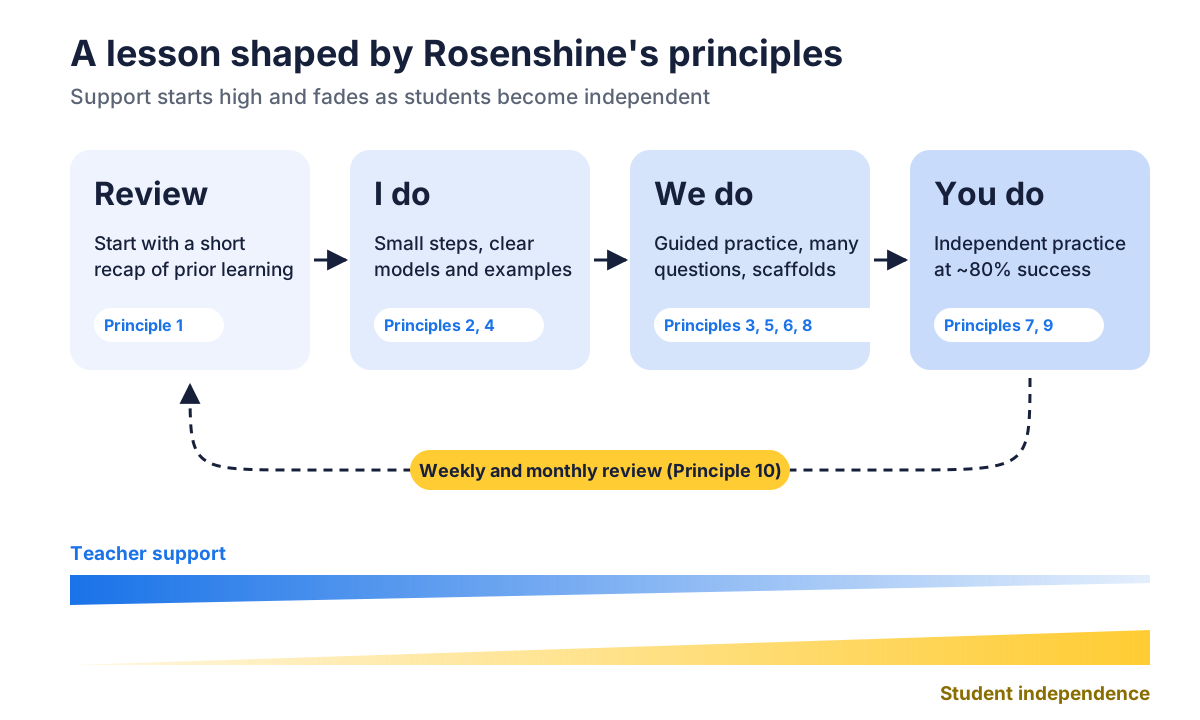
A sample lesson: solving two-step equations
Here is how a 60-minute maths lesson for 12- to 13-year-olds might look with the principles built in:
Time | Phase | What happens | Principles |
|---|---|---|---|
0–8 min | Review | Five Do Now questions: two on one-step equations (last lesson), two on negative numbers (last month), one on order of operations. | 1, 10 |
8–20 min | I do | Teacher models 3x + 5 = 20 step by step, thinking aloud. A second worked example, 4x − 7 = 13, with students predicting each step. | 2, 4 |
20–35 min | We do | Mini-whiteboard questions of increasing difficulty. Everyone shows answers; errors are discussed. A hinge question checks for the common mistake of dividing before subtracting. | 3, 5, 6 |
35–52 min | You do | Independent practice, starting with a partly worked example and ending with word problems. The teacher circulates and gives feedback. | 7, 8, 9 |
52–60 min | Exit check | Three questions on a slip of paper, handed in. The results decide where tomorrow's lesson starts. | 6 |
Common misunderstandings
"It's a checklist for every lesson"
Rosenshine described what effective teaching tends to look like over time, not a tick-box observation form. Not every lesson needs every principle, and a lesson full of practical work or discussion can still be excellent.
"It means lecturing"
Explicit instruction is highly interactive. Students answer questions constantly, practise after each small step, and get frequent feedback. Long, uninterrupted teacher talk is exactly what the principles warn against.
"It rules out independent or creative work"
The principles are about getting students to the point where they can work independently. Guidance matters most for novices. As students gain expertise, less structure is needed, and open-ended tasks become more productive.
Watch: the principles explained
This short video from the education researcher Nidhi Sachdeva summarises the principles and the research behind them.
Rosenshine's original article is free to read and remarkably accessible. It is well worth twenty minutes of any teacher's time: Principles of Instruction (American Educator, PDF).
Frequently asked questions
Are Rosenshine's principles only for maths and science?
No. They apply to any subject where students need to learn new knowledge and skills, from languages to history to PE. The examples change, but the structure of review, small steps, modelling, guided practice and independent practice carries over.
How do the principles relate to cognitive load theory?
They are closely aligned. Cognitive load theory explains why working memory limits matter. Many of the principles, such as small steps, worked examples and scaffolds, are practical ways of managing that load for novices.
Do the principles work for older students and adults?
The underlying cognitive science applies at every age. With more knowledgeable learners, you can move through the steps faster and hand over independence sooner.
References
Agarwal, P. K., Nunes, L. D., & Blunt, J. R. (2021). Retrieval practice consistently benefits student learning: A systematic review of applied research in schools and classrooms. Educational Psychology Review, 33(4), 1409–1453. doi.org/10.1007/s10648-021-09595-9
Black, P., & Wiliam, D. (1998). Assessment and classroom learning. Assessment in Education: Principles, Policy & Practice, 5(1), 7–74. doi.org/10.1080/0969595980050102
Kirschner, P. A., Sweller, J., & Clark, R. E. (2006). Why minimal guidance during instruction does not work: An analysis of the failure of constructivist, discovery, problem-based, experiential, and inquiry-based teaching. Educational Psychologist, 41(2), 75–86. doi.org/10.1207/s15326985ep4102_1
Rosenshine, B. (2012). Principles of instruction: Research-based strategies that all teachers should know. American Educator, 36(1), 12–19, 39. www.aft.org/sites/default/files/periodicals/Rosenshine.pdf
Rowe, M. B. (1986). Wait time: Slowing down may be a way of speeding up! Journal of Teacher Education, 37(1), 43–50. doi.org/10.1177/002248718603700110
Sweller, J. (1988). Cognitive load during problem solving: Effects on learning. Cognitive Science, 12(2), 257–285. doi.org/10.1207/s15516709cog1202_4
Sweller, J., & Cooper, G. A. (1985). The use of worked examples as a substitute for problem solving in learning algebra. Cognition and Instruction, 2(1), 59–89. doi.org/10.1207/s1532690xci0201_3


Discussion