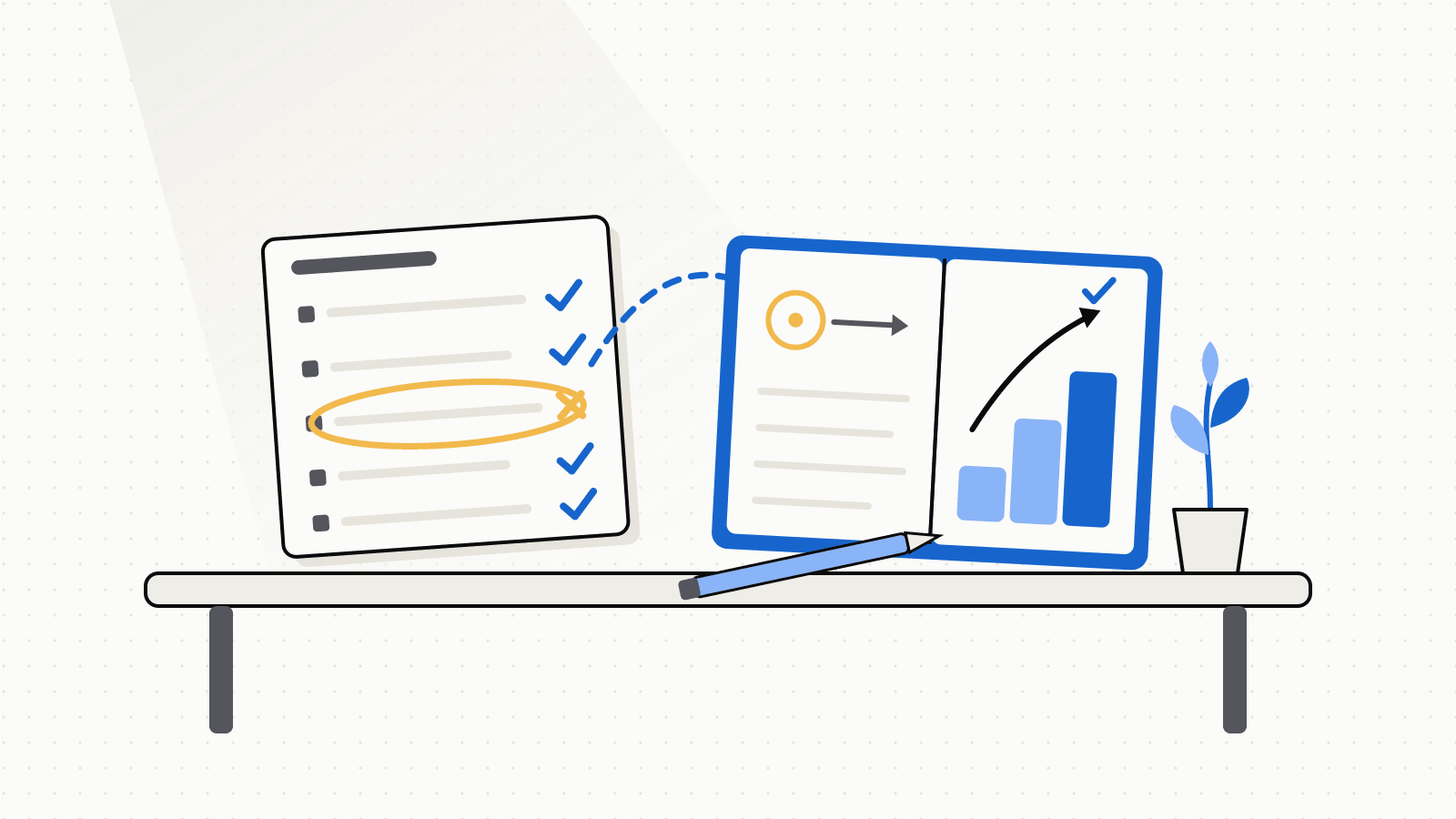
You get a quiz back with a red 62 at the top. What do you do next? Some students shove it in a backpack. Others stare at it, decide they are "just not a math person," and quietly stop trying. A few flip it open and start asking what went wrong.
That last reaction is the heart of the question: how do students with a growth mindset see their mistakes? They treat them as information. This article explains what that means, what brain research and large studies show, and how to turn it into a review routine you can use after any quiz, test, or homework set.
How do students with a growth mindset see their mistakes?
They see a mistake as a clue about a gap in knowledge or strategy, not as proof that they lack ability. The error says "this part isn't learned yet" or "this method didn't work," and it points toward what to do next.
This view comes from the framework Carol Dweck and Ellen Leggett laid out in 1988. When people see ability as something that develops through effort, a setback signals what to work on next (Dweck & Leggett, 1988; Dweck & Yeager, 2019). When they see ability as fixed, the same error turns into a verdict on intelligence.
The sections below cover how the two views differ, what happens in the brain after an error, a routine for reviewing mistakes, and an honest look at the limits of the research.
Growth vs. fixed mindset: how each responds to an error
Students who believe intelligence is static tend to prioritize performance goals, meaning looking smart. When they hit an error, they often blame low ability, pull back effort, or avoid the situation to protect their self-worth (Dweck & Leggett, 1988; Burnette et al., 2013; Dweck & Yeager, 2019). Students who believe ability grows with effort tend to set learning goals, solve problems actively, and manage themselves well after negative feedback (Dweck & Leggett, 1988; Burnette et al., 2013).
Question | Fixed mindset tendency | Growth mindset tendency |
|---|---|---|
What does a mistake mean? | "I'm not smart enough." | "I haven't learned this yet, or my method needs work." |
Main goal | Performance: look smart | Mastery: learn the material |
Typical reaction | Withdraw effort, avoid the topic | Active problem-solving |
Next step | Protect self-worth, hide confusion | Adjust, ask, try again |
Self-talk | "I'm bad at this." | "What did I miss?" |
What happens in the brain after a growth-minded student makes an error
Researchers can record electrical brain activity right after a person makes a mistake. One signal, called the error positivity (Pe), is linked to conscious awareness of an error and attention to it. Growth mindset is associated with a larger Pe, which suggests more attention to the mistake as it happens. That extra attention is related to better accuracy on the next try (Dweck & Yeager, 2019; Schroder et al., 2017).
The pattern shows up in young people too. A study of 123 school-aged children doing a go/no-go task, where they must respond to some signals and hold back on others, found the same link between growth mindset and error attention (Schroder et al., 2017). So this response appears early in school.
Example self-talk: from verdict to information
The words you use after an error shape what you do next. Here are three swaps students can borrow.
Verdict: "I'm just bad at chemistry." Information: "I missed the mole conversion. What step did I skip?"
Verdict: "I failed the quiz, so I'm not smart." Information: "This quiz shows which topics I haven't learned yet."
Verdict: "I won't ask, so no one sees I'm lost." Information: "Asking about this is the fastest way to fix it."
The first version in each pair protects self-worth but blocks learning. The second keeps the next step in view (Dweck & Leggett, 1988; Burnette et al., 2013; Dweck & Yeager, 2019).
Feeling disappointed is fine. The goal is not forced positivity. And effort alone is not enough: working harder with the same method rarely closes the gap, so the self-talk has to lead to a change in approach.
A step-by-step mistake review routine
Self-talk helps most when it leads to action. Use this routine after any quiz, test, or homework set. It puts into practice the learning-goal focus and active problem-solving that characterize growth-minded students (Dweck & Leggett, 1988; Burnette et al., 2013).
Pause and name the feeling. Say "I'm annoyed" or "I'm embarrassed," then come back when you are calm, later that day or the next.
Sort each error by type. Was it a knowledge gap, a careless slip, a misread question, or a strategy problem? Each type needs a different fix.
Write the correct reasoning in your own words. Copying the right answer is not enough. Explain why it works.
Pick one specific change. Try a new practice method, bring a question to your teacher, or approach the problem differently.
Retest yourself a few days later on a similar problem. This is a form of studying by testing yourself, and it shows whether the fix worked.
Worked example
A 10th grader misses six algebra word problems. Sorting the errors, she finds that her arithmetic was fine. Five of the six went wrong when she turned the sentences into equations. Her one change: for the next set, she underlines each quantity, labels it with a variable, and writes the equation before solving anything. Three days later she tries four fresh problems. If she gets them right, the fix worked. If not, she has a sharper question to bring to her teacher.
How parents and teachers can help students see mistakes as information
Ask better questions. "What did this mistake tell you?" and "What will you try next?" work better than reassurance or criticism of ability.
Praise strategies, questions, and revision rather than innate smartness.
Build in second chances. Teachers can allow correction and resubmission, and treat common errors as shared class material. This fits the spirit of formative assessment, where feedback guides learning instead of only ranking it.
Protect the climate. Evidence suggests mindset interventions help most for students at academic risk or from low-socioeconomic backgrounds (Yeager et al., 2019).
Skip empty slogans. Pair belief messages with real strategies and feedback (Dweck & Yeager, 2019).
When a student feels safe to be wrong, curiosity has room to grow. That connects to intrinsic motivation, the drive to learn for its own sake.
Does a growth mindset actually improve grades? What the evidence says
Honestly, the effects are modest. Meta-analyses find that mindset has small effects on achievement overall, and that interventions help in some contexts more than others (Sisk et al., 2018). A separate meta-analysis links mindset to self-regulation, which is part of why the idea is plausible (Burnette et al., 2013).
In a national sample of U.S. 9th graders, the average correlation between a fixed mindset and GPA was -.22 (Dweck & Yeager, 2019). That is a real but modest link: fixed beliefs tend to go with somewhat lower grades, and many other factors matter too.
The clearest gains came for students at academic risk. Online interventions raised lower-achieving students' GPA by about.10 grade points and improved their rates of staying on track for graduation by 4 to 8 percentage points (Dweck & Yeager, 2019).
Frequently asked questions
Do growth-minded students enjoy making mistakes?
Not necessarily. They can feel frustrated or disappointed like anyone else. The difference is what they do next: they analyze, adjust, and try again rather than withdraw.
Can a fixed mindset be changed?
Mindsets are beliefs, so they can shift, and interventions have helped some students, especially lower-achieving ones (Dweck & Yeager, 2019). Effects are modest on average, so pair belief change with better strategies and support (Sisk et al., 2018).
Is effort enough to overcome mistakes?
No. Effort works when it is paired with strategy changes and feedback. Repeating the same method harder rarely fixes the underlying gap.
How should a parent respond when a child brings home a bad grade?
Stay calm and ask what your child thinks happened. Then look at the errors together and settle on one specific next step, such as a question for the teacher or a different way to practice. Avoid comments about ability.
References
Burnette, J. L., O'Boyle, E. H., VanEpps, E. M., Pollack, J. M., & Finkel, E. J. (2013). Mind-sets matter: A meta-analytic review of implicit theories and self-regulation. Psychological Bulletin. doi.org/10.1037/a0029531
Dweck, C. S., & Leggett, E. L. (1988). A social-cognitive approach to motivation and personality. Psychological Review. doi.org/10.1037/0033-295x.95.2.256
Dweck, C. S., & Yeager, D. S. (2019). Mindsets: A View From Two Eras. Perspectives on Psychological Science. doi.org/10.1177/1745691618804166
Schroder, H. S., Fisher, M. E., Lin, Y., Lo, S. L., Danovitch, J. H., & Moser, J. S. (2017). Neural evidence for enhanced attention to mistakes among school-aged children with a growth mindset. Developmental Cognitive Neuroscience. doi.org/10.1016/j.dcn.2017.01.004
Sisk, V. F., Burgoyne, A. P., Sun, J., Butler, J. L., & Macnamara, B. N. (2018). To What Extent and Under Which Circumstances Are Growth Mind-Sets Important to Academic Achievement? Two Meta-Analyses. Psychological Science. doi.org/10.1177/0956797617739704
Yeager, D. S., Hanselman, P., Walton, G. M., Murray, J. S., Crosnoe, R., Muller, C., Tipton, E., Schneider, B., Hulleman, C. S., Hinojosa, C. P., Paunesku, D., Romero, C., Flint, K., Roberts, A., Trott, J., Iachan, R., Buontempo, J., Yang, S. M., Carvalho, C. M., … Dweck, C. S. (2019). A national experiment reveals where a growth mindset improves achievement. Nature. doi.org/10.1038/s41586-019-1466-y



Discussion