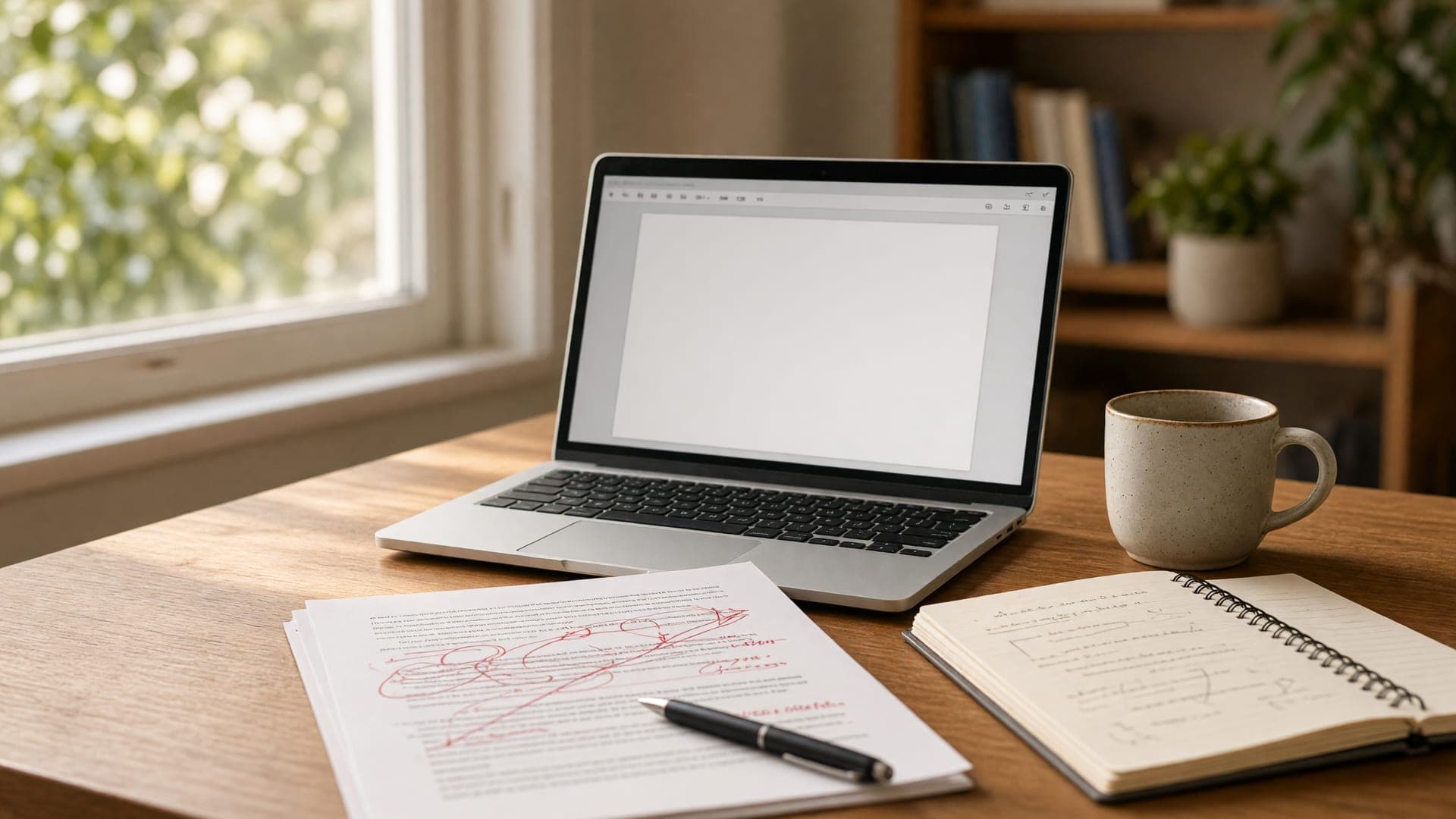
Most students know the feeling: the prompt is open, the cursor is blinking, and the deadline is closer than it should be. Then comes the pull to write the whole thing in one go and hope it hangs together. These essay writing tips replace that gamble with a process you can follow tonight.
If you arrived from an old ScholarOn writing services link, that service is no longer offered. This guide shows you how to write strong essays yourself, from prompt to proofread, including how to use AI tools without losing your own thinking or breaking your course's rules.
By the end, you will have a step-by-step method, before-and-after examples, a source-checking routine and a revision checklist.
Essay writing tips that start with how good writers work
A common belief says strong essays come from inspiration: you sit down and write from beginning to end in one sitting. That is a misconception. Quality comes from separate stages of planning, drafting and revising.
The research backs this up. A large meta-analysis of writing instruction found that teaching adolescent writers explicit strategies for planning, drafting and revising markedly improves the quality of their writing (Graham & Perin, 2007). Writers who plan on purpose do better than those who start a linear draft with no outline (Graham & Perin, 2007).
Why does this work? Trying to plan, draft and polish at the same moment overloads you. You are choosing ideas, finding words and fixing commas all at once. Give each job its own pass and each gets your full attention.
Writing also helps you learn. Another meta-analysis found that writing about texts you read, such as summaries and analytical responses, improves reading comprehension (Graham & Hebert, 2011). So the essay is not only a product. It is a way to understand the material.
How to write an essay, step by step
Here is a process you can start right now.
Decode the prompt. Underline the task verb (analyze, compare, argue), the scope and the length. Check the rubric. If anything is unclear, ask your instructor.
Research. Begin with assigned readings and library sources. Take notes in your own words and write down page numbers.
Draft a thesis. Write one arguable sentence. Expect to revise it later.
Outline. List each body paragraph's claim and the evidence you will use. A quick outline beats a linear draft with no plan (Graham & Perin, 2007).
Write a fast first draft. Keep going without stopping to fix grammar or hunt for the perfect word. Proofreading while drafting is a common time sink.
Revise for structure. Check the argument, the order, the logic and the gaps. Cut or move whole paragraphs.
Edit line by line. Refine sentence flow, clarity, word choice and tone.
Proofread last. Fix spelling, punctuation, formatting and citations, ideally after a break or by reading aloud.
If starting is the hardest part, our guide on how to stop procrastinating can help you get the first twenty minutes done.
How to write a strong thesis and paragraphs that argue
These academic writing tips come down to one idea: argue, don't just describe. A thesis makes a claim someone could reasonably dispute, and it previews your reasoning.
Weak vs. strong at a glance
Weak versions describe a topic. Strong versions argue a position.
Weak thesis: "Social media has many effects on teenagers."
Strong thesis: "Because social media rewards constant comparison, schools should teach students to audit their own feeds rather than ban phones outright."
The strong one takes a position, gives a reason and implies what the essay must prove. Test yours this way: could a thoughtful classmate disagree? If not, sharpen the claim.
The same gap shows up in topic sentences.
Weak: "Another point is school start times."
Strong: "Later school start times matter most because they align class hours with teenagers' sleep needs."
A paragraph skeleton to reuse
Build each body paragraph in four moves:
Claim: a focused topic sentence that advances the thesis.
Evidence: a quotation, data or example from a vetted source.
Analysis: two or more sentences explaining how the evidence supports the claim. This is where most weak paragraphs fall short.
Link: a sentence tying the point back to the thesis or leading into the next paragraph.
One paragraph, one job. If a paragraph argues two things, split it.
Finding and using scholarly sources well
Start with your syllabus readings and your library's databases, then use Google Scholar to search more broadly. Peer-reviewed journals have been vetted by expert reviewers before publication.
Read a paper efficiently. Take the abstract first, then the discussion or conclusion. Turn to the methods and results only if you need them.
Writing about what you read, through summaries and notes in your own words, strengthens comprehension (Graham & Hebert, 2011). Our guide to strategies for reading comprehension goes deeper.
Paraphrase, quote and cite
Paraphrase to explain an idea in your own words and structure. Quote only when the exact wording matters. Either way, cite.
Accidental plagiarism often starts with sloppy notes. Mark quotations clearly and record the source immediately.
Use the citation style your course requires (APA, MLA or Chicago). A reference manager such as Zotero stores sources and formats citations, but check its output against the style guide.
Best writing tools by job, including AI writing tools for students
The best AI writing tools for students are the ones used for a specific job, with your judgment in charge. Here is how common tools fit the work.
Job | Tools | Use them for |
|---|---|---|
Research | Google Scholar, your library databases | Finding peer-reviewed sources |
Citations | Zotero, Purdue OWL | Saving sources, formatting, and checking style rules |
Grammar and clarity | Grammarly, Microsoft Editor, Hemingway Editor | Catching errors and flagging long or dense sentences |
Feedback | Writing center, instructor, peers, AI chat assistants | Spotting gaps in your argument |
No tool replaces your judgment. Accept a suggestion only if you understand it.
Using AI well
Ask for counterarguments, logical gaps and unclear sentences in your own draft. This resembles writing center coaching. Then you decide what to change and write every word.
Using AI badly
The poor uses are generating text you submit, drafting arguments you have not examined, or relying on AI-supplied sources you have not opened. Chatbots predict plausible text rather than retrieve verified facts, so they can invent paper titles, journals, page numbers and DOIs. When researchers checked 636 references that ChatGPT wrote for short literature reviews, 55% of GPT-3.5's and 18% of GPT-4's were fabricated (Walters & Wilder, 2023).
The speed is real. In one experiment, generative AI cut the time spent on midlevel professional writing tasks by 40% and raised output quality by 18% (Noy & Zhang, 2023). But those were workplace tasks, not graded learning, and faster output is not the same as learning to write.
A revision checklist you can use tonight
Run these checks in order: structure before sentences, sentences before typos.
Argument: Does the thesis answer the prompt? Does every paragraph support it?
Structure: Does each paragraph have one claim, evidence and analysis? Is the order logical?
Evidence: Is each source real, relevant and cited? Did you open and confirm every reference?
Line edit: Cut filler, vary sentence length, replace vague words and keep a consistent tone.
Proofread: Check spelling, punctuation, formatting and citation style, ideally after a break or read aloud.
Integrity: Is every idea and phrase properly attributed, and is any AI use disclosed as your course requires?
Ways to improve your writing skills over time
One good essay helps. A habit helps more. These are practical ways to improve writing skills beyond a single assignment.
Read good writing in your field. Notice how authors build arguments and transitions.
Write often. Short, low-stakes pieces such as summaries and explanations count, and writing about what you read helps you understand it (Graham & Hebert, 2011).
Get feedback, then revise. Instructors, writing centers and peers can show you what you cannot see in your own draft.
Learn strategies explicitly. Planning, drafting and revising strategies improve quality (Graham & Perin, 2007).
Explain your argument aloud in plain language, as in the Feynman technique, to find holes before you draft.
Test yourself on your evidence without notes, using active recall, so you can argue from understanding rather than copied text.
Frequently asked questions
Why do AI chatbots invent fake citations?
They predict likely text rather than look up verified records, so they can produce realistic but nonexistent titles, journals, page numbers and DOIs (Walters & Wilder, 2023). Always open each source in a library database or Google Scholar and confirm it exists and says what is claimed.
Can I use AI for my essay without breaking academic integrity rules?
It depends on your course policy, so read it and ask your instructor if it is unclear. Feedback, brainstorming counterarguments and clarity checks on your own draft are commonly allowed, but submitting AI-written text usually is not. Disclose your use when required.
What is the difference between revising, editing and proofreading?
Revising fixes argument, structure and logic. Editing improves sentence flow, clarity and tone. Proofreading catches surface errors and citation details, and it comes last.
How long should I spend on each stage of an essay?
There is no fixed split, but give planning and revision real time rather than rushing to a draft. Set a deadline for each stage, and use time-blocking to protect those sessions.
References
Graham, S., & Hebert, M. (2011). Writing to Read: A Meta-Analysis of the Impact of Writing and Writing Instruction on Reading. Harvard Educational Review. doi.org/10.17763/haer.81.4.t2k0m13756113566
Graham, S., & Perin, D. (2007). A meta-analysis of writing instruction for adolescent students. Journal of Educational Psychology. doi.org/10.1037/0022-0663.99.3.445
Noy, S., & Zhang, W. (2023). Experimental evidence on the productivity effects of generative artificial intelligence. Science. doi.org/10.1126/science.adh2586
Walters, W. H., & Wilder, E. I. (2023). Fabrication and errors in the bibliographic citations generated by ChatGPT. Scientific Reports. doi.org/10.1038/s41598-023-41032-5



Discussion